Why Pairing Exfoliation and Hydration Works
Dead‑cell buildup creates a rough, impermeable layer that traps oils and blocks humectants, leaving the skin dehydrated and dull. Exfoliation gently removes this barrier, exposing fresh keratinocytes that can readily absorb moisture. Immediately after cleansing, a hydrating serum—rich in hyaluronic acid, glycerin, or panthenol—replenishes water and lipids, while ceramides and squalane seal the renewed surface, restoring the skin’s protective barrier. This two‑step synergy boosts cell turnover, plumps fine lines, evens tone, and enhances product penetration, resulting in a luminous, youthful glow. Consistent pairing, followed by sunscreen, keeps the skin resilient, reduces the appearance of fine lines, and supports long‑term skin health.
The Science Behind Exfoliation and Hydration
Exfoliation & Hydration Overview
| Process | What It Does | Benefits | Risks of Over‑exfoliation |
|---|---|---|---|
| Exfoliation | Removes dead‑cell debris & clogged corneodesmosomes | Clears barrier, allows actives to penetrate deeper | Strips protective oils, leads to tightness, redness, flakiness, sensitivity |
| Hydration | Applies humectants (HA, glycerin, PGA, panthenol) & barrier lipids (ceramides, squalane) | Replenishes water & lipids, restores lipid‑film, reduces TEWL | N/A |
| Synergy | Fresh surface + locked‑in moisture | Plump, smooth, resilient skin | N/A |
| Guidelines | Dry/sensitive: 1 × /week; Normal/combination: 1‑2 × /week; Oily: 2‑3 × /week | Optimizes renewal while protecting barrier | Follow with hydrating serum on damp skin, barrier‑supporting moisturizer, then sunscreen |
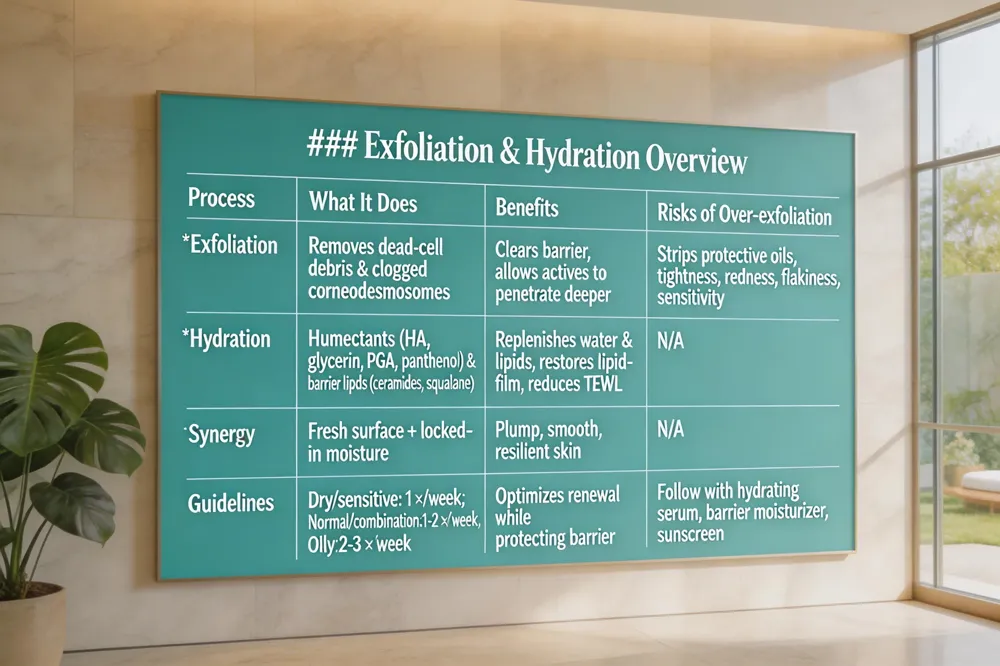 Exfoliation clears away dead‑cell debris that blocks the skin’s “brick‑and‑mortar” barrier, allowing humectants and actives to reach deeper layers. Once the stratum corneum is free of clogged corneodesmosomes, hyaluronic acid, glycerin, ceramides, squalane and panthenol can replenish lost water and lipids, restoring the lipid‑film that keeps transepidermal water loss in check. This creates a synergistic renewal cycle: a fresh, exfoliated surface readily absorbs moisture, and the renewed hydration reinforces the barrier, keeping skin plump, smooth and resilient. However, over‑exfoliation strips protective oils, weakens the barrier, and can cause tightness, redness, flakiness and increased sensitivity. To avoid these risks, follow U.S. guidelines—1 × week for dry/sensitive skin, 1–2 × week for normal/combination, and up to 2–3 × week for oily skin—and always follow with a hydrating serum on damp skin and a barrier‑supporting moisturizer before sunscreen.
Choosing the Right Exfoliant for Your Skin Type
Exfoliant Selection Matrix
| Skin Type | Ideal Acid/Ingredient | Mechanism | Frequency |
|---|---|---|---|
| Dry / Sensitive | AHAs (glycolic, lactic, mandelic) – gentle PHAs | Dissolve inter‑cellular bonds; provide humectant benefit | 1 × /week |
| Normal / Combination | AHAs (moderate) or BHAs (salicylic) | AHAs brighten; BHAs clear pores | 1‑2 × /week |
| Oily / Acne‑prone | BHAs (salicylic) – oil‑soluble, penetrates pores | Clears excess sebum & debris | 2‑3 × /week |
| Sensitive / Reactive | PHAs, enzyme peels (papaya, pineapple), ultra‑fine physical scrubs | Larger molecules stay surface; minimal pH shift | 1 × /week |
| Resilient / Tolerant | Adjustable‑depth devices (e.g., PMD Microderm Elite Pro) | Controlled mechanical exfoliation | 2‑3 × /week |
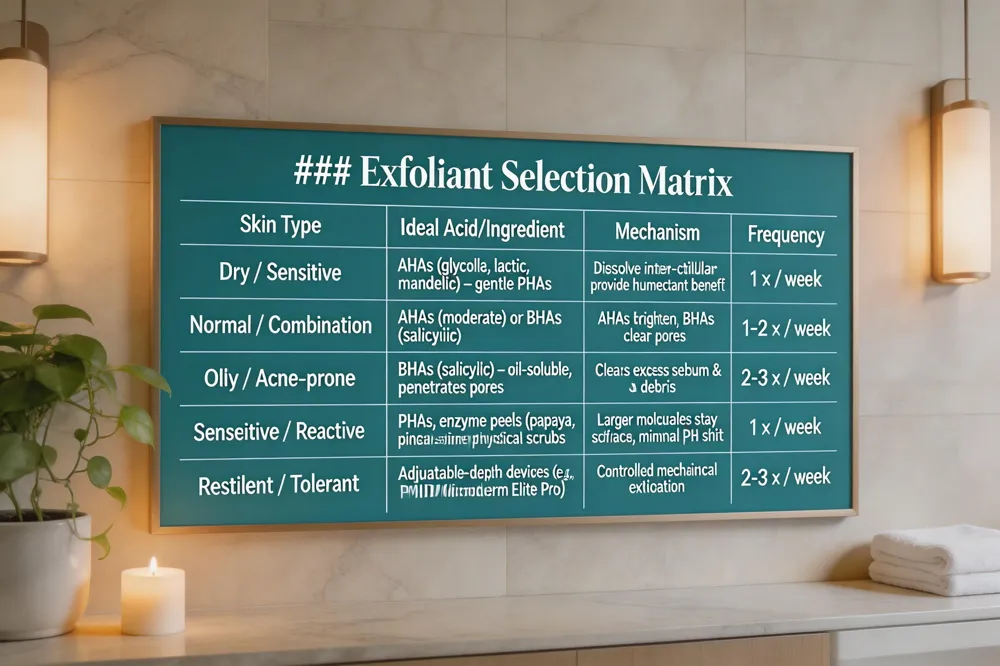 When picking an exfoliant, start with the acid family that best matches your skin’s needs. AHAs (glycolic, lactic, mandelic) dissolve the bonds between dead surface cells, making them ideal for dull, dry, or mature skin that craves brightness and fine‑line smoothing. BHAs, most commonly salicylic acid, are oil‑soluble and penetrate pores to clear excess sebum and debris—perfect for oily or acne‑prone complexions. PHAs offer a gentler alternative with larger molecules that stay near the surface, delivering exfoliation plus humectant benefits for sensitive or reactive skin. If you prefer non‑acid options, enzyme‑based pe (papaya, pineapple) or ultra‑fine physical scrubs can loosen dead cells without altering pH. Frequency should be tailored: 1 × weekly for sensitive/dry skin, 1–2 × weekly for normal/combination, and up to 2–3 × weekly for oily or resilient skin. For precise, adjustable results, devices like the PMD Personal Microderm Elite Pro let you control depth and intensity, reducing the risk of over‑exfoliation while still prepping the skin for optimal hydration.
Key Hydrating Ingredients That Supercharge Skin
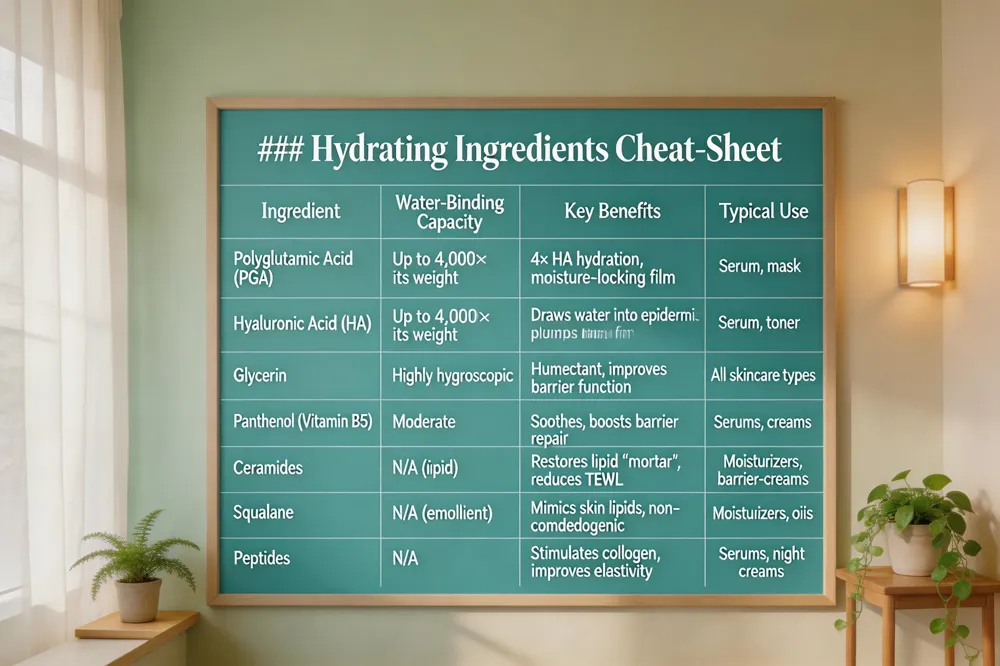
Hydrating Ingredients Cheat‑Sheet
| Ingredient | Water‑Binding Capacity | Key Benefits | Typical Use |
|---|---|---|---|
| Polyglutamic Acid (PGA) | Up to 4,000 × its weight | 4× HA hydration, forms moisture‑locking film | Serum, mask |
| Hyaluronic Acid (HA) | Up to 1,000 × its weight | Draws water into epidermis, plumps skin | Serum, toner |
| Glycerin | Highly hygroscopic | Humectant, improves barrier function | All skincare types |
| Panthenol (Vitamin B5) | Moderate | Soothes, boosts barrier repair | Serums, creams |
| Ceramides | N/A (lipid) | Restores lipid “mortar”, reduces TEWL | Moisturizers, barrier‑creams |
| Squalane | N/A (emollient) | Mimics skin lipids, non‑comedogenic, adds shine | Moisturizers, oils |
| Peptides | N/A | Stimulates collagen, improves elasticity | Serums, night creams |
 What skin is four times more hydrating than hyaluronic acid?
Polyglutamic Acid (PGA) can bind up to 4,000 times its weight in water, delivering roughly four‑times the hydration of hyaluronic acid. By forming a moisture‑locking film, PGA keeps the skin plump, soft and reduces fine‑line visibility. It works synergistically with HA for deep and surface hydration.
What skin is four times more hydrating than hyaluronic acid?
Polyglutamic Acid (PGA) can bind up to 4,000 times its weight in water, delivering roughly four‑times the hydration of hyaluronic acid. By forming a moisture‑locking film, PGA keeps the skin plump, soft and reduces fine‑line visibility. It works synergistically with HA for deep and surface hydration.
What ingredients best improve skin hydration and elasticity? Hyaluronic acid is a humectant that draws water into the epidermis. Ceramides, squalane, glycerin and panthenol restore the lipid barrier, sealing in moisture and preventing transepidermal water loss. Peptides stimulate collagen production, enhancing elasticity and firmness. Together these ingredients create a resilient, hydrated complexion that glows after exfoliation.
Dermatologist‑Recommended Hydrating Serums
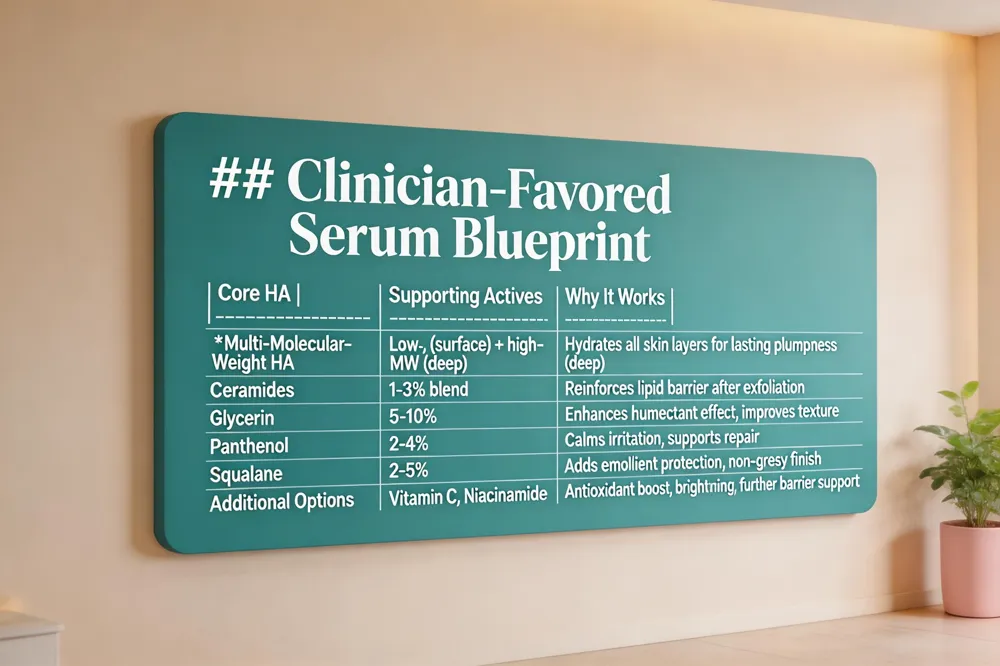
Clinician‑Favored Serum Blueprint
| Core HA | Supporting Actives | Why It Works |
|---|---|---|
| Multi‑Molecular‑Weight HA | Low‑, (surface) + high‑MW (deep) | Hydrates all skin layers for lasting plumpness |
| Ceramides | 1‑3 % blend | Reinforces lipid barrier after exfoliation |
| Glycerin | 5‑10 % | Enhances humectant effect, improves texture |
| Panthenol | 2‑4 % | Calms irritation, supports repair |
| Squalane | 2‑5 % | Adds emollient protection, non‑greasy finish |
| Additional Options | Vitamin C, Niacinamide | Antioxidant boost, brightening, further barrier support |
 Why HA‑based serums are a staple
Hyaluronic acid (HA) is a sugar‑based humectant that can bind up to 1,000 times its weight in water pulling moisture into the stratum corneum and reducing transepidermal water loss. Because dead‑cell buildup blocks humectants, a post‑exfoliation serum rich in HA restores the skin’s plumpness and smoothness.
Top clinician‑favored formulas
Dermatologists look for serums that combine HA with barrier‑supporting ingredients such as ceramides, glycerin, squalane, and panthenol (Vitamin B5). These components lock in water, replenish lipids, and soothe the skin after the mild irritation that exfoliation can cause.
Benefits of multi‑molecular‑weight HA and added ceramides
Formulations that include several HA molecular sizes penetrate different skin layers, delivering surface hydration and deeper, long‑lasting moisture. Ceramides reinforce the lipid “mortar” between corneocytes, preventing the barrier from becoming compromised after exfoliation.
How to layer serums after exfoliation
After cleansing and gentle exfoliation, apply a hydrating serum on still‑damp skin to maximize absorption, then seal the moisture with a ceramide‑rich moisturizer. Finish with a broad‑spectrum SPF 30+ sunscreen to protect the newly exposed cells.
Which hydrating serums are recommended by dermatologists?
Clinicians consistently endorse serums that feature HA together with glycerin, ceramides, squalane, or panthenol. These ingredients work synergistically to replenish water, restore barrier function, and keep the skin supple and radiant after exfoliation.
Special Skin Concerns: Perioral Dermatitis & Benzoyl Peroxide
Perioral Dermatitis & BPO Guidance Table
| Scenario | Recommended Action | Rationale |
|---|---|---|
| Perioral Dermatitis | Avoid any exfoliant (AHAs, BHAs, scrubs) | Skin barrier already compromised; exfoliation worsens TEWL and irritation |
| Gentle Care | Fragrance‑free, pH‑balanced cleanser + barrier‑repair moisturizer (ceramides, HA, panthenol) | Restores barrier, reduces flakiness |
| Benzoyl Peroxide (BPO) Use | Separate from exfoliation (different day or ≥ 4 h apart) | Prevents excessive irritation from combined keratolytic effects |
| If Exfoliation Desired with BPO | Use low‑percentage AHA (≤ 5 %) or mild physical scrub, monitor skin response | Minimizes barrier disruption while still providing some cell turnover |
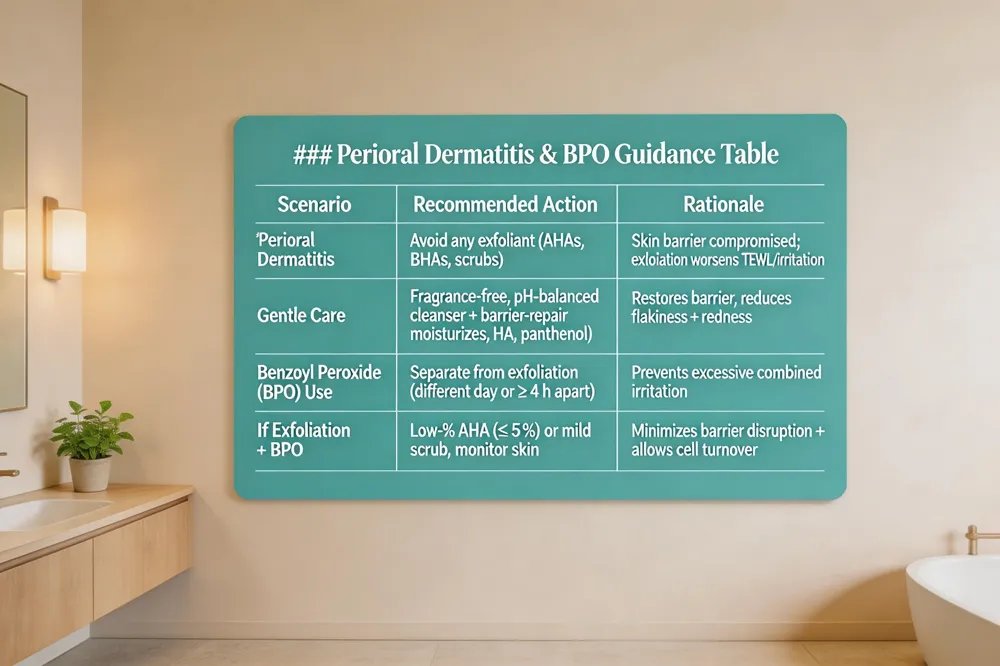 Exfoliation removes dead cells, but in perioral dermatitis the barrier is already weakened; AHAs , BHAs or physical scrubs can strip remaining lipids, raise transepidermal water loss, and provoke redness and flakiness. A gentle‑care routine should begin with a fragrance‑free, pH‑balanced cleanser and a soothing, non‑comedogenic moisturizer that includes barrier‑repair ingredients such as ceramides, hyaluronic acid or panthenol. Avoid alcohol‑based toners, harsh scrubs and high‑strength acids; keep the area clean, moisturized and free of irritants like fluoride toothpaste or topical steroids.
Should I exfoliate if I have perioral dermatitis? No—exfoliating can aggravate the condition by further disrupting the compromised barrier and increasing irritation. Stick to a minimal‑care approach with a gentle cleanser and a barrier‑supporting moisturizer.
Can I exfoliate while using benzoyl peroxide? It’s best to separate the two. If you wish to exfoliate, choose a low‑percentage AHA or a mild physical scrub and apply it on a different day or several hours apart from benzoyl peroxide, then follow with a hydrating moisturizer and watch for excess redness.
Building a Post‑Exfoliation Routine for a Youthful Glow
Post‑Exfoliation Routine Checklist
| Step | Product Type | Timing | Key Points |
|---|---|---|---|
| 1️⃣ Cleanse | Gentle, lukewarm water + mild cleanser | Immediately after exfoliation | Remove residual acid without stripping oils |
| 2️⃣ Serum | Hydrating serum (HA ± glycerin/panthenol) | Within 5‑10 min on still‑damp skin | Locks in moisture, enhances penetration |
| 3️⃣ Moisturizer | Ceramide‑rich barrier cream | After serum absorption | Seals humectants, restores lipid barrier |
| 4️⃣ SPF | Broad‑spectrum SPF 30+ | Morning, last step | Protects newly exposed cells from UV damage |
| Weekly Frequency | Dry/sensitive: 1 × /week; Normal/combination: 1‑2 × /week; Oily/resilient: 2‑3 × /week | — | Follow same daily hydration steps regardless of frequency |
| Optional Boost | Professional treatment (PMD microdermabrasion or HydraFacial) | Periodic (e.g., monthly) | Combines controlled exfoliation with deep hydration for intensified glow |
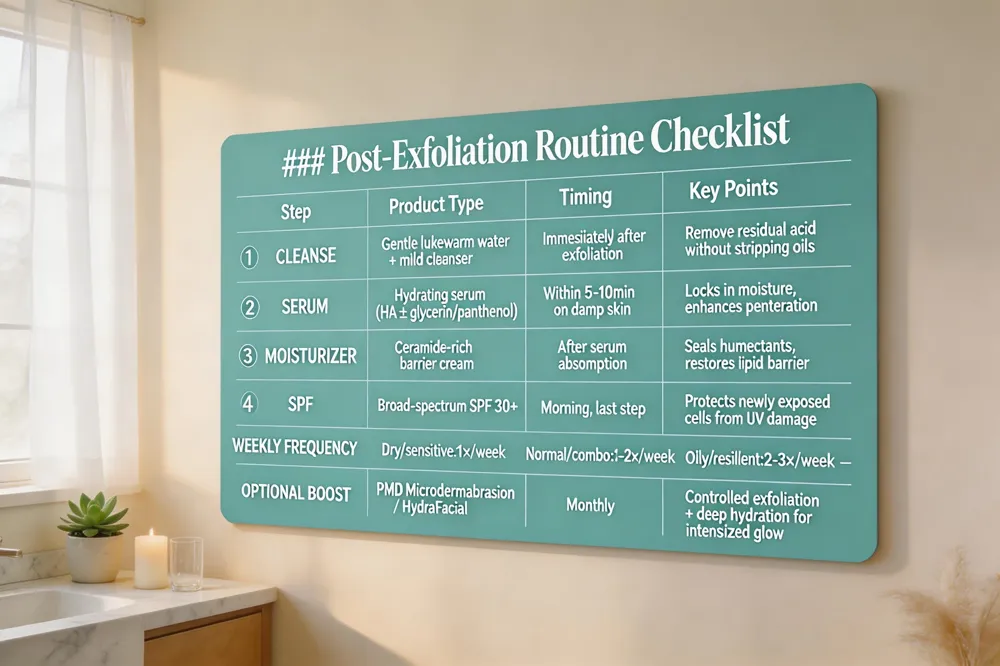 Start with a gentle cleanse using lukewarm water to remove residual exfoliant without stripping natural oils. Within 5‑10 minutes, while the skin is still damp, apply a hydrating serum packed with hyaluronic acid, glycerin, or panthenol to lock in moisture. Follow with a ceramide‑rich moisturizer that restores the lipid barrier and seals the humectants in place. Finish every morning with a broad‑spectrum SPF 30+ sunscreen to protect the newly exposed cells from UV damage.
Weekly frequency checklist:
- Sensitive/dry skin – 1×/week exfoliation, then the post‑exfoliation steps daily.
- Normal/combination skin – 1–2×/week.
- Oily/resilient skin – up to 2–3×/week, always followed by the same hydration sequence.
For an extra boost, consider a professional treatment such as PMD microdermabrasion or a HydraFacial which pairs controlled exfoliation with deep hydration for an intensified glow.
Your Path to Radiant, Hydrated Skin
The synergy of exfoliation and hydration is the cornerstone of a glowing complexion. By clearing away dead‑cell buildup, exfoliation opens the skin’s pores and allows humectants—such as hyaluronic acid, glycerin, and squalane—to sink deeper, delivering lasting plumpness. Recommended pairings include a gentle AHA/BHA serum followed by a ceramide‑rich moisturizer, or a PHA‑based scrub topped with a panthenol‑infused cream for sensitive or acne‑prone skin. Safety first: limit exfoliation to 1–2 times weekly for normal skin, less for dry or reactive types, and always patch‑test new acids. After each session, seal the barrier with a barrier‑supporting moisturizer and finish with SPF 30+ to protect the fresh layer. Ready for a custom plan? Schedule a personalized consultation at Timeless Med Spa and let experts design the perfect exfoliation‑hydration routine for you.