Why Dermal Fillers Matter in Today’s Aesthetic Landscape
Non‑surgical facial rejuvenation has exploded across the United States, with over three million Americans seeking quick, minimally invasive solutions each year. Dermal fillers sit at the heart of this trend, offering a natural‑enhancement strategy that restores volume, softens lines, and contours features without downtime or surgery. Before committing, patients weigh several key factors: the filler’s composition (hyaluronic acid for reversibility, calcium hydroxylapatite for structural lift, PLLA for collagen stimulation, or PMMA for semi‑permanent results), expected longevity, cost, and the provider’s expertise in anatomy and injection technique. Selecting a board‑certified injector who personalizes treatment ensures safe, subtle outcomes that blend seamlessly with each individual’s unique facial dynamics.
Understanding Filler Types and Top Brands
Filler Categories & Top Brands
| Category | Brands (examples) | Key Characteristics | Typical Longevity |
|---|---|---|---|
| Hyaluronic‑acid (HA) gels | Juvéderm (Voluma, Volbella, Vollure, etc.), Restylane (Lyft, Kysse, Silk), Belotero, RHA line, Teosyal | Soft, low‑viscosity; reversible with hyaluronidase; excellent for fine lines & lips | 6‑18 months |
| Calcium‑hydroxylapatite (CaHA) | Radiesse | Thick, high‑G′ gel; provides immediate lift & collagen stimulation; not reversible | 12‑24 months |
| Poly‑L‑lactic acid (PLLA) | Sculptra | Low‑viscosity polymer; biostimulatory – collagen builds over months; requires series of injections | 12‑24 months (effects can last 2‑3 years) |
| Polymethyl‑methacrylate (PMMA) microspheres | Bellafill | Permanent scaffold; semi‑permanent correction of deep folds & scars | Up to 5 years |
| Polyalkylimide (semi‑permanent) | Aquamid | Semi‑permanent, non‑resorbable; smooth texture | 3‑5 years |
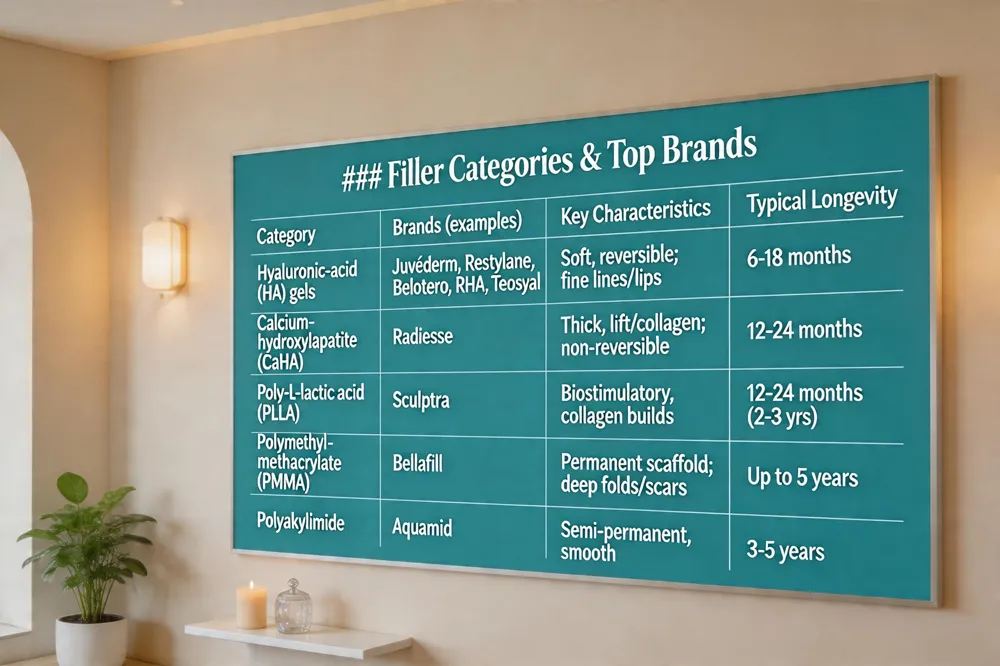 Dermal fillers approved by the FDA fall into four main categories: hyaluronic‑acid (HA) gels, calcium‑hydroxylapatite (CaHA) microsphere suspensions, poly‑L‑lactic acid (PLLA) biostimulators, and polymethyl‑methacrylate (PMMA) microsphere fillers. The molecular makeup of each group dictates its rheology—HA fillers are soft and low‑viscosity for fine lines, CaHA offers a thicker, high‑G′ gel for deep creases, PLLA is a low‑viscosity polymer that stimulates collagen over months, and PMMA provides a permanent scaffold. Longevity follows the same pattern: HA lasts 6‑18 months, CaHA and PLLA 12‑24 months, and PMMA can endure for years.
Top 10 filler brands – Juvéderm (Voluma, Volbella, Vollure, etc.), Restylane (Lyft, Kysse, Silk), Belotero, RHA line, Sculptra, Radiesse, Bellafill, Teosyal, Aquamid, and EZ Gel PRF. These cover HA, CaHA, PLLA, PMMA, and semi‑permanent options.
Types of filler brands – HA fillers (Restylane, Juvéderm, Belotero, RHA) are reversible and ideal for lips and superficial wrinkles; CaHA (Radiesse) provides firm lift and collagen boost; PLLA (Sculptra) builds collagen gradually for long‑lasting mid‑face volume; PMMA (Bellafill) and polyalkylimide (Aquamid) give semi‑permanent correction.
Best dermal filler brands – Juvederm and Restylane for natural, versatile HA results; Belotero for ultra‑smooth fine lines; Sculptra for multi‑year collagen stimulation; Radiesse for immediate deep‑fold lift; Bellafill for durable scar and fold treatment.
Hyaluronic acid dermal filler types – Restylane (Lyft, Silk), Juvéderm (Ultra, Voluma, Volbella), Belotero Balance, Teosyal, and RHA lines each vary in cross‑link density and particle size to match treatment depth and desired longevity.
Most natural‑looking filler – HA fillers blend with the skin’s own HA, offering lifelike hydration and volume; skilled injectors enhance this effect.
Longest‑lasting filler – Bellafill (PMMA microspheres) can last up to five years, outlasting HA, CaHA, and PLLA options.
Safety: Juvederm vs. Restylane – Both are FDA‑approved HA products with comparable safety; choice depends on injector experience and specific treatment goals.
Hashimoto’s patients – HA fillers are generally safe, but a full medical review is essential.
Age 70+ – Healthy seniors can receive Botox and fillers; plans are tailored to skin quality and health status.
Natural filler for the face – HA fillers and autologous PRF EZ Gel provide biologically compatible, discreet enhancement.
Longevity, Cost, and What Patients Can Expect
Duration & Cost Overview
| Filler Type | Typical Duration | Avg Cost per Syringe (USD) | Notes |
|---|---|---|---|
| HA (e.g., Juvederm, Restylane) | 6‑12 months (some up to 18 months) | $715 (range $500‑$800) | Immediate volume, reversible |
| CaHA (Radiesse) | 12‑18 months | $901 (range $800‑$1,200) | Firm lift, collagen boost |
| PLLA (Sculptra) | 2‑3 years (after series) | $901 (range $800‑$1,200) | Gradual collagen stimulation |
| PMMA (Bellafill) | Up to 5 years | $901 (range $800‑$1,200) | Semi‑permanent, not reversible |
| Semi‑permanent (Aquamid) | 3‑5 years | $901 (range $800‑$1,200) | Durable, smooth texture |
| Costs vary by region, injector expertise, and number of syringes required. |
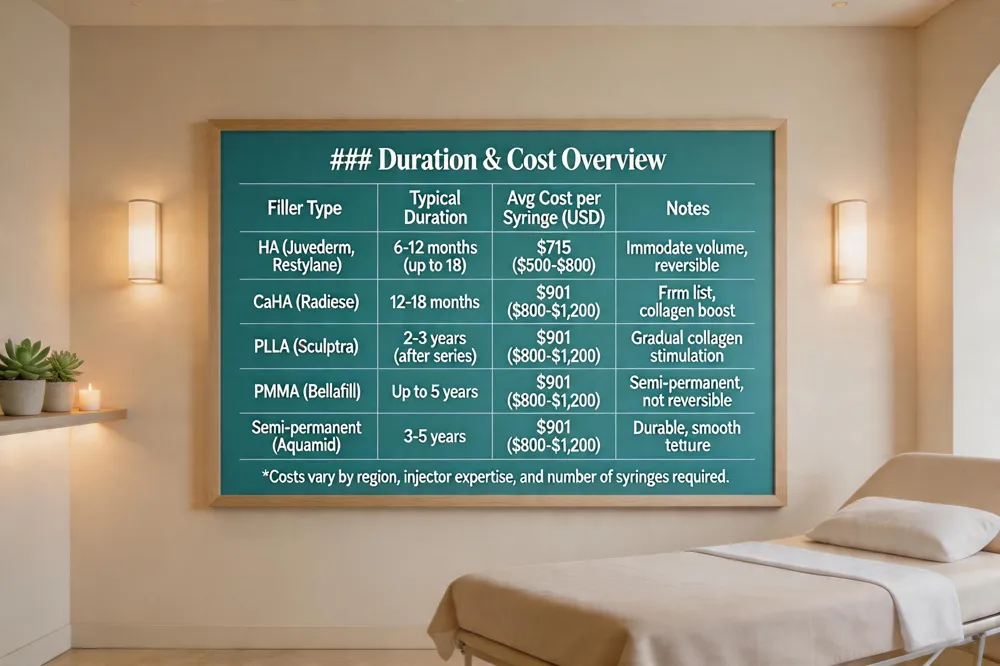 Dermal fillers are grouped by material, which predicts how long their effect lasts. Hyaluronic‑acid (HA) products such as Juvederm, Restylane and Belotero are soft gels that hydrate skin and typically give results for 6‑12 months, with some cross‑linked formulas extending to 18 months. Calcium‑hydroxylapatite (CaHA) fillers like Radiesse provide a thicker, structural lift and last about 12‑18 months while stimulating new collagen. Poly‑L‑lactic acid (PLLA) biostimulators such as Sculptra work more slowly, building collagen over several months; results can persist 2‑3 years after a series of treatments. Polymethyl‑methacrylate (PMMA) microsphere fillers (Bellafill) are semi‑permanent, offering up to five years of correction.
How long a filler stays depends on product viscosity, injection depth, metabolic rate, facial movement and the area treated (deep cheek augmentation end longer than superficial fine‑line work). Post‑treatment care—avoiding vigorous exercise, UV exposure and blood‑thinners—also helps preserve results.
Cost varies by filler type and region. In the United States a typical HA syringe ranges $500‑$800 (average $715), while non‑HA options such as Radiesse, Sculptra and Bellafill are $800‑$1,200 per syringe (average $901). Prices rise with the number of syringes required, provider expertise and geographic market; most clinics, including Timeless Med Spa in Berlin, NJ, do not accept insurance for cosmetic fillers but often offer financing plans.
FAQs
- Face fillers cost: $500‑$1,500 per syringe; HA about $715, non‑HA about $900.
- Dermal filler injection price: 0.5 ml HA $500‑$800; premium products $800‑$1,200.
- Botox San Francisco cost: $10‑$15 per unit, typically $300‑$800 for common treatment areas.
- Which filler makes your face look younger? HA fillers for immediate volume, CaHA for deeper structural lift, PLLA for collagen‑stimulated long‑term rejuvenation, and Bellafill for semi‑permanent correction.
- What is the new filler that lasts 5 years? Bellafill™ provides up to five years of nasolabial‑fold improvement.
- What is the best dermal filler for the face? For natural results most clinicians favor HA fillers (Juvederm Voluma, Restylane Lyft) for volume and RHA® for dynamic areas; PLLA offers longer‑lasting collagen buildup, and PMMA is reserved for deep, permanent correction.
Safety, Side Effects, and Managing Expectations
Safety Profile & Management
| Issue | Common Presentation | Management | Reversibility |
|---|---|---|---|
| Immediate reactions (redness, swelling, bruising) | Mild, resolves 1‑2 days | Ice, NSAIDs, elevation | N/A |
| Delayed nodules / granulomas | Firm bumps weeks‑months later | Hyaluronidase (for HA), corticosteroids, antibiotics | HA‑ reversible; others may need excision |
| Vascular occlusion | Pain, blanching, livedo‑reticularis | Immediate hyaluronidase (HA), warm compress, aspirin, possible surgery | HA reversible; non‑HA may require surgical intervention |
| Infection | Redness, warmth, fever | Antibiotics, possible drainage | N/A |
| Over‑correction / “pillow‑face” | Excess volume, unnatural contour | Hyaluronidase (HA), massage, possible revision | HA reversible; non‑HA not reversible |
 Dermal fillers are generally safe when administered by a board‑certified injector who follows proper screening and after‑care protocols. Common immediate reactions include mild redness, swelling, bruising, and tenderness that resolve within 1–2 days. Delayed reactions may appear weeks later as nodules, granulomas, or persistent discoloration. Rare but serious complications such as vascular occlusion, infection, or tissue necrosis require prompt treatment—hypertrophy of HA fillers can be reversed with hyaluronidase, and vascular events need immediate medical intervention, potentially with hyal,idase, anticoagulants, or surgical care. Reversibility of HA fillers: Because hyaluronic acid is enzymatically degradable, hyaluronidase can dissolve excess or misplaced filler, restoring a natural look. Patient screening involves reviewing medical history, allergies, and medication use (e.g., blood thinners, NSAIDs) to minimize bruising and infection risk. After‑care advises avoiding strenuous exercise and prolonged sun exposure for 24–48 hours, applying gentle cooling, and monitoring for signs of infection or prolonged swelling.
Do fillers ruin your face? No—when performed correctly they subtly restore volume without “pillow‑face.” Over‑filling or improper placement can cause lumps, but these are avoidable with an experienced injector and appropriate product choice. Hyaluronic‑acid fillers can be dissolved if needed.
Side effects of dermal fillers are usually mild (bruising, swelling, tenderness) and resolve quickly; rare complications include nodules, migration, and vascular occlusion, which are treated promptly.
Which is safer, Juvederm or Restylane? Both are FDA‑approved HA fillers with comparable safety records; the injector’s skill and product selection for the specific area matter more than brand.
Mabrie Facial Institute reviews highlight personalized care, natural results, and high patient satisfaction (≈4.8‑star ratings).
Best injector San Francisco: Board‑certified dermatologists or plastic surgeons with strong portfolios, such as Dr. Mabrie’s team, consistently receive high ratings and deliver natural, safe outcomes.
Can I get fillers with Hashimoto’s? HA fillers are generally safe for autoimmune patients, but a thorough medical evaluation is essential.
Is 70 too old for Botox and fillers? Age alone isn’t a contraindication; healthy patients over 70 can be treated with adjusted plans for skin quality and health status.
Real‑World Results and Patient Stories
Typical Outcomes & Follow‑up
| Treatment Area | Expected Outcome | Typical Follow‑up | Patient Satisfaction |
|---|---|---|---|
| Lips (HA) | Fuller, hydrated lips; natural feel | 2‑week check for adjustment | 4.5‑5 /5 (many report natural look) |
| Nasolabial folds (HA/CaHA/PMMA) | Smoother folds, lifted cheek contour | 4‑6 weeks to assess final result | High (≥4 /5) |
| Mid‑face volume (PLLA) | Gradual collagen build, lasting lift | Series of 3‑4 sessions, 4‑6 weeks apart | Positive long‑term feedback |
| Acne scars (PMMA) | Durable scar flattening, improved texture | 1‑month post‑procedure review | Very high (≥4.8 /5) |
| Under‑eye hollows (HA) | Subtle fill, reduced dark circles | 1‑week for swelling resolution | Generally satisfied |
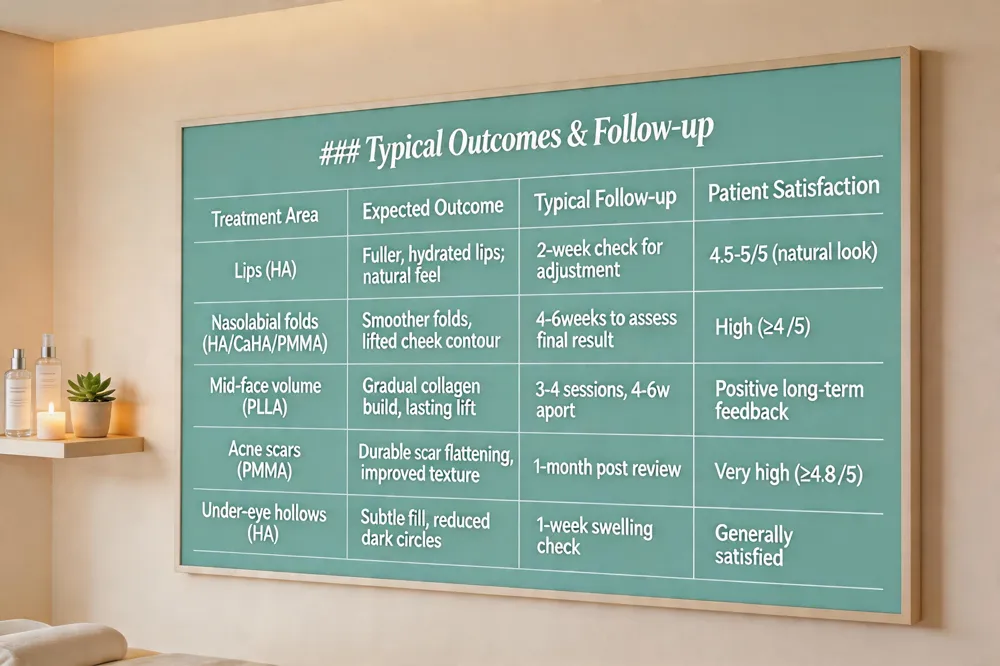 Before‑and‑after photos are the most persuasive proof of how dermal fillers can subtly restore youthfulness. The images typically show smoother nasolabial folds, lifted cheeks, and fuller lips while preserving natural facial contours. Patients often notice a reduction in under‑eye hollows and Marionette lines, giving a refreshed look that still feels authentic.
Managing expectations for lip fillers is essential. Short‑term results—sometimes lasting only a month—are usually due to rapid metabolic breakdown of a low‑density hyaluronic‑acid gel, superficial placement, or lifestyle factors such as smoking and excessive sun exposure. Choosing a higher‑density HA product (e.g., Juvéderm Volure or Restylane Lyft) and following post‑care guidance can extend longevity. A two‑week follow‑up lets the clinician assess the outcome and adjust the plan for a more durable, natural enhancement.
When fillers under‑perform, clinicians address the issue by first evaluating injection depth, product choice, and patient metabolism. They may re‑inject a thicker filler, adjust technique, or recommend a different formulation better suited to the treatment area.
Common filler brands include Restylane, Juvéderm (Voluma, Volbella, Voluxe, Vollure), Belotero, Radiesse (calcium‑hydroxylapatite), Sculptra (poly‑L‑lactic acid), Aquamid (polyalkylimide), and Bellafill (PMMA microspheres). Each formulation offers distinct properties: HA fillers provide immediate, reversible volume; CaHA offers firmer, longer‑lasting lifts; PLLA stimulates collagen gradually for lasting restoration; and PMMA delivers semi‑permanent correction for deep wrinkles. These options enable personalized, natural‑looking results tailored to each patient’s goals.
Advanced Options, Emerging Technologies, and Personalized Care
Emerging Technologies & Ideal Use‑Cases
| Technology | Mechanism | Longevity | Ideal Indications |
|---|---|---|---|
| HA fillers with RHA® technology | Dynamic cross‑linking for movement‑friendly areas | 6‑12 months | Perioral lines, dynamic wrinkles |
| CaHA with integrated lidocaine | Immediate lift + collagen stimulation | 12‑18 months | Deep nasolabial folds, cheek augmentation |
| PLLA (Sculptra) with proprietary bead size | Biostimulation of collagen over months | 2‑3 years (effects persist up to 5 years) | Mid‑face volume loss, gradual rejuvenation |
| PMMA microspheres (Bellafill) | Permanent scaffold + collagen integration | Up to 5 years | Persistent nasolabial folds, acne scars |
| Polyalkylimide (Aquamid) | Semi‑permanent, non‑bio‑resorbable polymer | 3‑5 years | Long‑lasting facial contouring |
| Autologous PRF EZ Gel | Platelet‑rich fibrin gel, growth‑factor driven | Variable (months) | Natural, subtle enhancement; patients preferring autologous material |
 Dermal fillers are categorized by their active ingredient and mechanism of action. Hyaluronic‑acid (HA) fillers, such as Juvéderm and Restylane, are the most natural‑looking because they blend with the skin’s existing HA, are reversible with hyaluronidase, and provide smooth hydration and volume. Calcium‑hydroxylapatite (CaHA) fillers like Radiesse add immediate lift and stimulate collagen, ideal for deeper folds but not reversible. Poly‑L‑lactic acid (PLLA) and polymethyl‑methacrylate (PMMA) are biostimulatory agents that promote long‑term collagen production; PLLA results appear gradually over months, while PMMA microspheres (Bellafill™) can last up to five years, making Bellafill the longest‑lasting injectable approved. For patients seeking durable structural support, Bellafill offers semi‑permanent correction of nasolabial folds and acne scars, though it requires an experienced injector. Overall, HA fillers remain the top choice for natural, reversible outcomes, while CaHA, PLLA, and PMMA provide longer‑lasting options tailored to each client’s anatomy and aesthetic goals.
Putting It All Together: A Personalized Path to Natural Facial Refinement
Choosing the right dermal filler begins with understanding the main categories: hyaluronic‑acid (HA) gels such as Juvederm and Restylane that are reversible and last 6‑12 months; calcium‑hydroxyapatite (CaHA) like Radiesse for deeper folds and 12‑18 months of lift; poly‑L‑lactic acid (PLLA) Sculptra that stimulates collagen production and can last up to years; polymethyl‑acrylate (PMMA) microspheres for lasting support. Safety hinges on FDA‑approved products, thorough medical histories, and avoidance of anticoagulants before treatment. Costs vary $500‑$1,200 per session, reflecting filler type and area treated. Board‑certified injectors ensure precise anatomy knowledge and customize volumes for each face, minimizing risks. At Timeless Med Spa, every plan is crafted to deliver natural, graceful enhancement while prioritizing patient safety and personalized care.