Introduction
Light‑based therapies have become a cornerstone of modern cosmetic skincare because they target specific skin concerns without surgery, offering natural‑looking rejuvenation and minimal downtime. The two most popular modalities—laser and Intense Pulsed Light (IPL)—share the principle of using light energy, yet they differ fundamentally in how that energy is delivered. Lasers emit a single, focused wavelength that concentrates high energy into a deep, precise column, making them ideal for treating deep pigmentation, scar tissue, and stubborn vascular lesions. IPL, by contrast, uses a broad spectrum of wavelengths filtered to cover larger surface areas, excelling at superficial issues such as mild hyperpigmentation, rosacea, and fine vascular spots while also providing efficient hair‑removal for lighter skin tones. Deciding which technology suits you involves evaluating your skin type, the depth of your concern, budget, and tolerance for downtime. A qualified practitioner will assess your Fitzpatrick skin rating, desired outcomes, and medical history to recommend a personalized plan—whether that’s a series of IPL photofacials for broad‑area rejuvenation or a targeted laser protocol for deeper, more dramatic results.
Laser vs. IPL: Core Differences and Cost Considerations
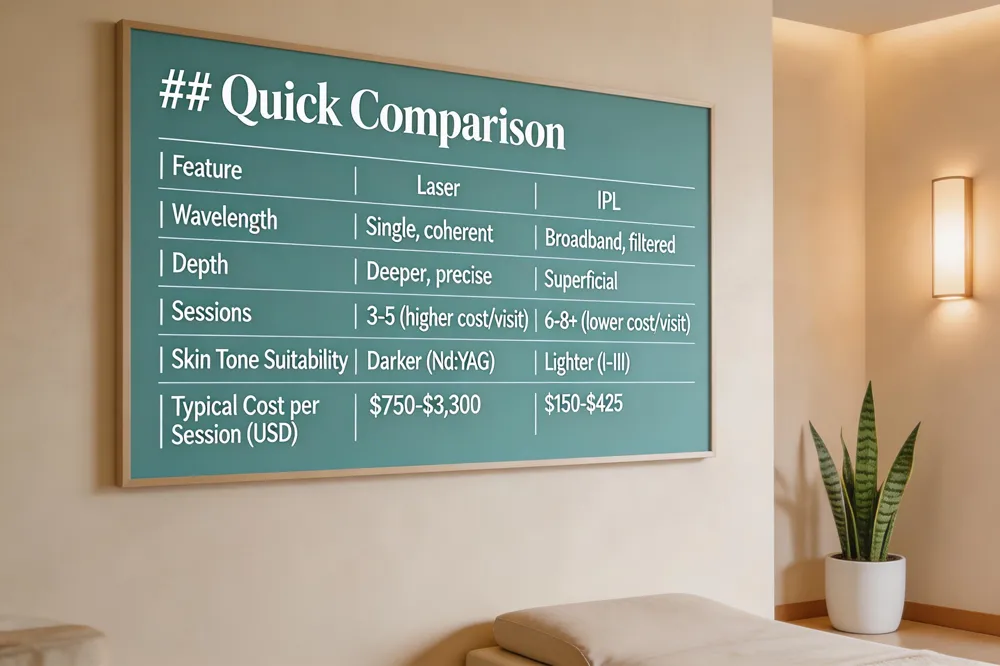
Quick Comparison
| Feature | Laser | IPL |
|---|---|---|
| Wavelength | Single, coherent | Broadband, filtered |
| Depth | Deeper, precise | Superficial |
| Sessions | 3‑5 (higher cost/visit) | 6‑8+ (lower cost/visit) |
| Skin Tone Suitability | Darker (Nd:YAG) | Lighter (I‑III) |
| Typical Cost per Session (USD) | $750‑$3,300 | $150‑$425 |
 Single‑wavelength versus broad‑spectrum light
Laser devices emit a single, coherent wavelength that concentrates energy into a narrow beam, allowing precise targeting of deep chromophores such as melanin, hemoglobin, or water. IPL (Intense Pulsed Light) uses a broadband, non‑coherent spectrum filtered to treat multiple concerns in one pulse, covering larger surface areas but with less focal intensity.
Depth of penetration and precision
Because lasers deliver higher fluence at a specific wavelength, they penetrate deeper and can remodel scar tissue, deep pigmentation, and stimulate collagen with fractional technology (e.g., CO₂, Er:YAG). IPL’s broader spectrum reaches the dermis more gently, making it ideal for superficial issues—sun spots, rosacea, fine vascular lesions, and mild hyperpigmentation—while typically requiring more sessions for comparable depth.
Typical per‑session pricing and total cost
In the United States, IPL sessions range from $150‑$425 (often $250‑$500 for larger areas). Laser resurfacing, especially CO₂ or fractional systems, costs $750‑$3,300 per visit. Although laser per‑session fees are higher, fewer visits (3‑5) are usually needed, whereas IPL may require 6‑8+ sessions. When total visits are tallied, overall expense can converge, making budget a personal decision based on desired speed of results.
Suitability for different skin tones
IPL absorbs melanin more readily, increasing the risk of post‑inflammatory hyperpigmentation in Fitzpatrick IV‑VI skin; it works best on lighter tones (I‑III) with dark hair. Nd:YAG and other longer‑wavelength lasers safely treat darker skin because their energy bypasses superficial melanin, reducing pigment‑related complications.
Key takeaways
- Laser: precise, deeper, faster dramatic improvement, higher cost per session, suitable for darker skin and deep concerns.
- IPL: versatile, broader coverage, lower per‑session price, gentler downtime, best for superficial issues on lighter skin.
Choosing the right modality hinges on the depth of the problem, skin type, budget, and how quickly you want to see results. A board‑certified aesthetic professional can tailor a plan that aligns with your individual goals.
Hair Removal Showdown: Laser, IPL, and Alternatives
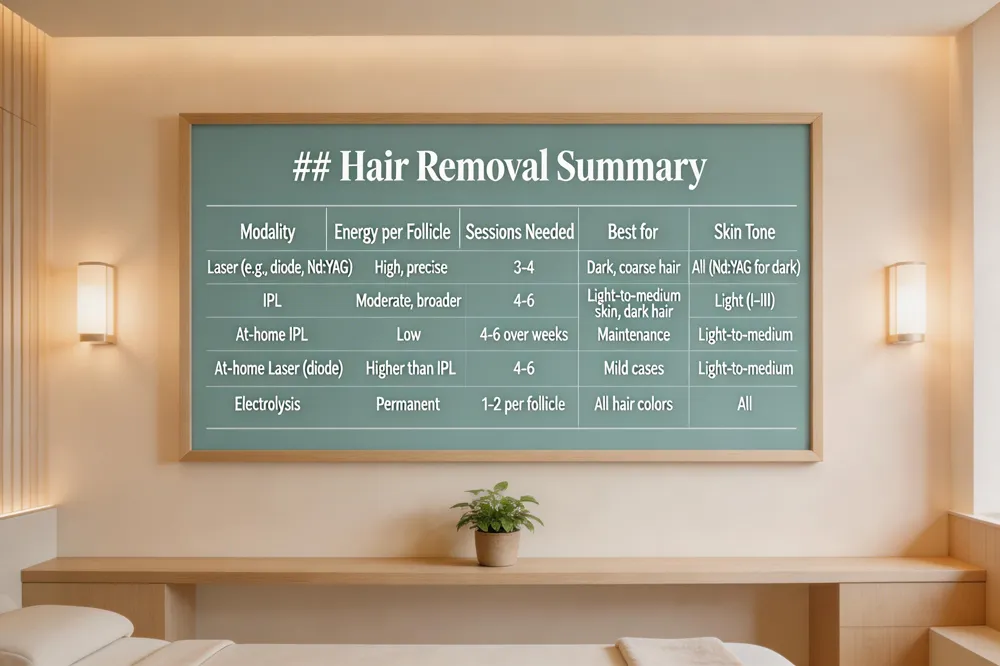
Hair Removal Summary
| Modality | Energy per Follicle | Sessions Needed | Best for | Skin Tone |
|---|---|---|---|---|
| Laser (e.g., diode, Nd:YAG) | High, precise | 3‑4 | Dark, coarse hair | All (Nd:YAG for dark) |
| IPL | Moderate, broader | 4‑6 | Light‑to‑medium skin, dark hair | Light (I‑III) |
| At‑home IPL | Low | 4‑6 over weeks | Maintenance | Light‑to‑medium |
| At‑home Laser (diode) | Higher than IPL | 4‑6 | Mild cases | Light‑to‑medium |
| Electrolysis | Permanent | 1‑2 per follicle | All hair colors | All |
 When it comes to removing unwanted hair, the technology you choose can dramatically affect results, comfort, and cost.
Mechanisms of hair follicle targeting Laser devices emit a single, concentrated wavelength that is absorbed by melanin in the hair bulb, generating enough heat to permanently weaken the follicle. IPL (Intense Pulsed Light) uses a broad spectrum of wavelengths; filters narrow the range, allowing larger spot sizes and customizable settings, but the energy per follicle is lower and less precise.
Session count and long‑term efficacy Clinical laser hair‑removal protocols typically need 3‑4 treatments to see noticeable reduction, with lasting outcomes that can persist for years. IPL generally requires 4‑6 sessions spaced 2‑4 weeks apart and often yields semi‑permanent results that may need touch‑ups.
Home‑device options versus professional clinics At‑home IPL units are safe for light‑to‑medium skin and dark hair but deliver milder energy, so users see modest hair‑count drops after many sessions (often 4‑6 treatments over 12‑16 weeks). Home laser systems, such as FDA‑cleared diode devices, provide higher energy per pulse and can reduce hair by up to 80 % in a few weeks, yet they are pricier and may be limited to certain skin tones. Professional in‑clinic laser remains the gold standard for deep, coarse, or darker hair, while at‑home devices are best for maintenance or mild cases.
Safety for different skin tones Laser platforms can be tuned (e.g., Nd:YAG 1064 nm) to safely treat darker Fitzpatrick IV‑VI skin with minimal melanin absorption. IPL is most effective on lighter skin (I‑III) and dark hair; without proper filters it raises the risk of post‑inflammatory hyperpigmentation in darker tones.
Laser versus IPL for the face Facial hair removal benefits from laser’s precise focus, delivering strong results after 3‑4 sessions with lower pigment‑change risk. IPL can cover the delicate facial area quickly but may produce uneven outcomes on darker skin and generally needs 4‑6 sessions.
Laser, IPL, and electrolysis Electrolysis offers true permanent removal for any hair color or skin type by inserting a probe into each follicle, but it is slower, more painful, and best for small zones. Laser provides rapid, long‑lasting reduction for dark hair on light skin; IPL is a lower‑cost, broader‑area alternative with semi‑permanent results.
Special considerations Active HPV warts should be cleared before any light‑based treatment; laser does not treat the virus itself but can irritate lesions.
Acne and Overall Skin Rejuvenation: What Works Best?
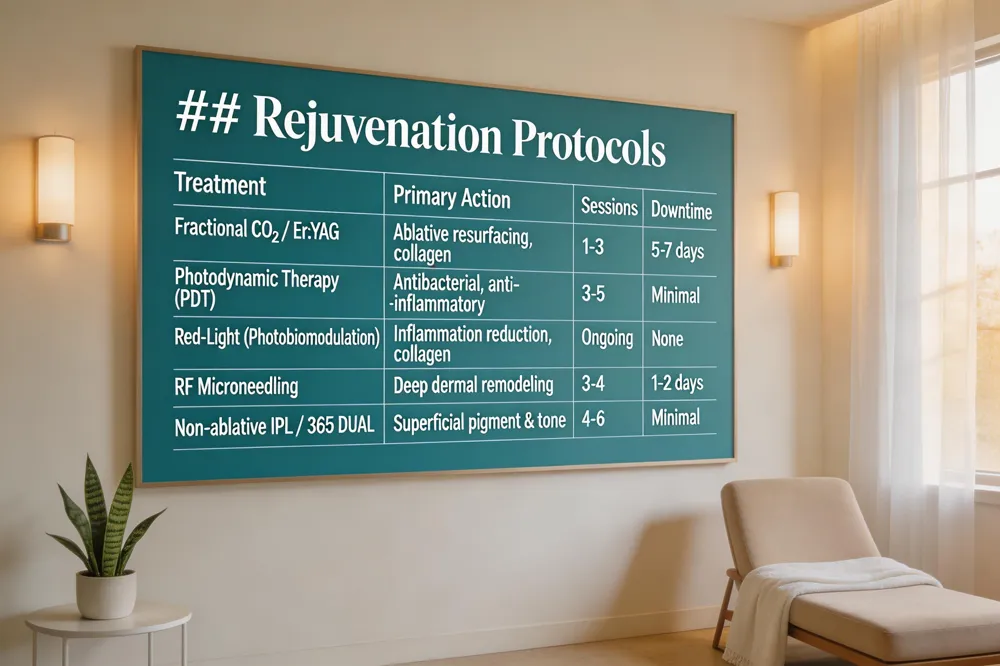
Rejuvenation Protocols
| Treatment | Primary Action | Sessions | Downtime |
|---|---|---|---|
| Fractional CO₂ / Er:YAG | Ablative resurfacing, collagen | 1‑3 | 5‑7 days |
| Photodynamic Therapy (PDT) | Antibacterial, anti‑inflammatory | 3‑5 | Minimal |
| Red‑Light (Photobiomodulation) | Inflammation reduction, collagen | Ongoing | None |
| RF Microneedling | Deep dermal remodeling | 3‑4 | 1‑2 days |
| Non‑ablative IPL / 365 DUAL | Superficial pigment & tone | 4‑6 | Minimal |
 When it comes to acne‑related skin rejuvenation, the most reliable approach is a combined laser protocol. A fractional CO₂ or Er:YAG laser resurfaces the epidermis, removes clogged pores, and triggers deep collagen remodeling, while a follow‑up photodynamic therapy (PDT) or low‑level red‑light (photobiomodulation) session tackles the acne‑causing bacteria and calms inflammation. This dual strategy clears active breakouts, minimizes post‑acne hyperpigmentation, and smooths scarring in far fewer sessions than IPL or chemical peels alone.
Dermatologists often favor a fractional CO₂ laser paired with radio‑frequency microneedling for broader rejuvenation goals. The ablative laser delivers dramatic tightening by vaporizing the outer skin layer, and the RF microneedling reinforces deeper dermal fibers with minimal downtime. For patients with milder concerns or those who prefer less invasive options, non‑ablative lasers such as IPL, fractional 365 DUAL, or even LED‑based red‑light therapy can boost collagen, improve tone, and reduce superficial pigmentation while keeping recovery to a few hours.
In short, the most effective skin‑rejuvenation regimen is a personalized blend of fractional laser resurfacing (CO₂ or Er:YAG) and adjunctive modalities—whether PDT, red‑light therapy, or RF microneedling—tailored to the individual’s skin type, acne severity, and downtime tolerance.
The overall benefits are clear: increased collagen production for firmer, plumper skin; reduction of fine lines, wrinkles, and uneven texture; fading of sun spots and melasma; and a more even, radiant complexion. Patients report a healthier, youthful glow that enhances confidence while preserving a natural appearance.
Pigmentation, Rosacea, and Pre‑/Post‑Treatment Care
Care Checklist
| Step | IPL | IPL |
|---|---|---|
| Pre‑treatment | Avoid sun, no tanners 2 wks | Same |
| Post‑treatment | Cool gel, SPF 30+, moisturizer | Same |
| Typical Cost (USD) | $300‑$600 per session | $150‑$425 per session |
| Best for | Deep pigment, melasma | Superficial pigment, rosacea |
| Skin Tone | Darker (Nd:YAG) | Lighter (I‑III) |
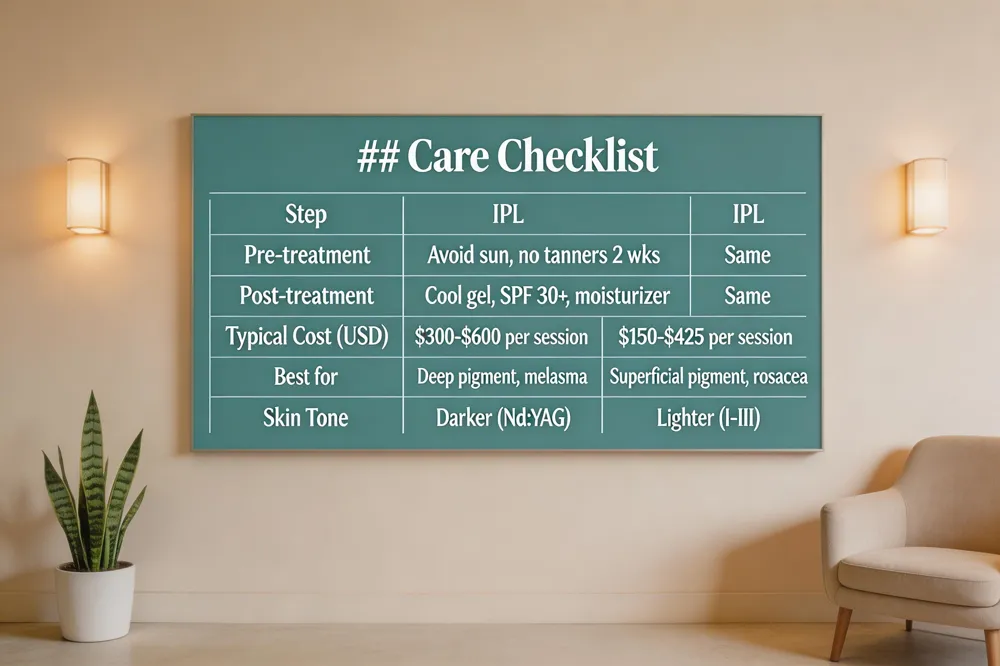 When it comes to fading unwanted pigment and calming facial redness, both IPL (Intense Pulsed Light) and laser therapy have distinct strengths.
IPL vs laser for pigmentation – Laser devices such as a Q‑switched Nd:YAG emit a single, focused wavelength that penetrates deeper and can break down stubborn melanin deposits, often delivering faster, more uniform clearing of sun spots, melasma, and other deep pigment. IPL, by contrast, uses a broad‑spectrum light with multiple wavelengths, making it gentler and ideal for treating larger surface areas and superficial discoloration. Because IPL’s energy is diffused, downtime is minimal and redness usually resolves within a day; laser procedures may cause stronger redness, swelling, or brief crusting that can last several days.
IPL vs laser for rosacea – IPL’s customizable broadband flash can target superficial blood vessels, offering an effective, low‑downtime option for mild‑to‑moderate rosacea and simultaneous treatment of sun damage or pigment. Vascular lasers (e.g., pulsed‑dye or Vbeam) emit a single, highly focused wavelength that penetrates deeper, contracting larger or more resistant vessels and often achieving noticeable reduction in fewer sessions. IPL is generally cheaper and more comfortable, but for stubborn redness or telangiectasia, laser remains the “gold standard.”
Cost of IPL for rosacea – A single IPL session typically ranges from $300 to $600 in U.S. med spas, with a series of 3‑5 treatments bringing total investment to $900‑$3,000. Prices vary by treatment area size, clinician expertise, and device technology (e.g., Sciton Joule). Many clinics, including Timeless Med Spa in Berlin, NJ, offer package discounts to keep costs transparent and competitive.
Pre‑ and post‑treatment care – Patients should avoid sun exposure, tanning beds, and self‑tanners for at least two weeks before IPL. Arrive with clean, makeup‑free skin. During the 10‑15‑minute session a cooling gel is applied; the light feels like gentle rubber‑band snaps. After treatment, a soothing moisturizer and SPF are essential. Expect mild redness for 24‑48 hours, followed by gradual fading of pigmented spots and rosacea over the next week. Most patients see a 30‑50 % reduction in discoloration after 3‑6 sessions, achieving a smoother, more even complexion with natural, graceful results.
Age, Safety, and Special Situations
Age & Skin‑Type Guidance
| Age Group | Recommended Laser | Considerations |
|---|---|---|
| 20‑40 | Non‑ablative fractional | Fast recovery |
| 40‑70 | Fractional CO₂ with lower fluence | Thinner skin, slower healing |
| Fitzpatrick IV‑VI | Nd:YAG, non‑ablative | Avoid IPL |
| Pubic Hair | IPL (intimate device) | Dark hair, light skin |
| Celeb‑fav | Clear + Brilliant® (non‑ablative) | Minimal downtime |
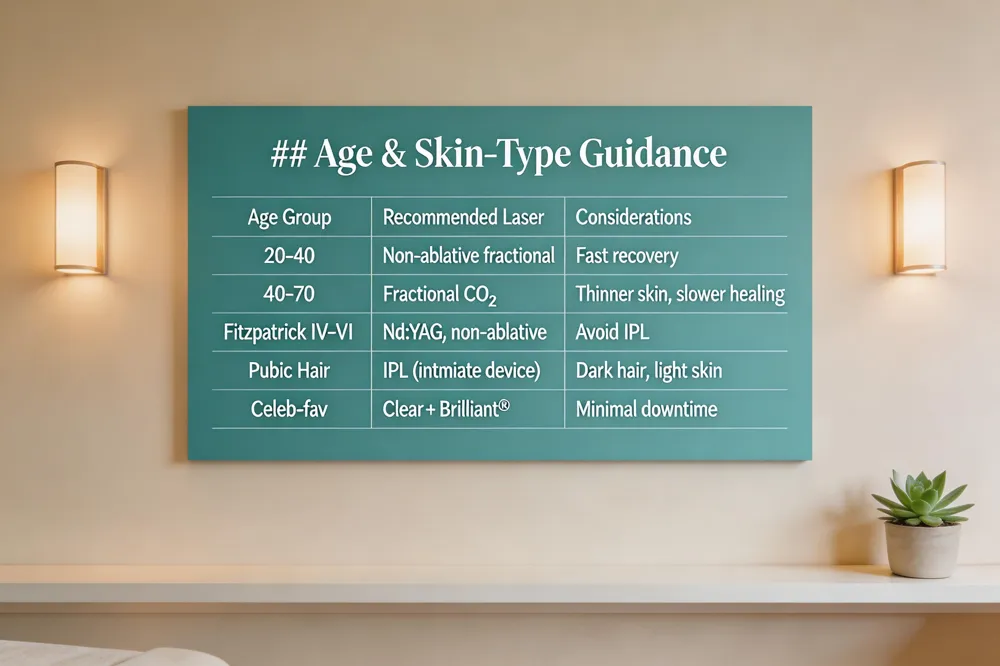 When considering light‑based rejuvenation, age, skin type, and treatment area all influence the choice between IPL and laser technologies.
Laser suitability for older patients – Age alone is not a contraindication for laser resurfacing. Even at 70, patients can benefit from fractional CO₂ or Er:YAG lasers, which use lower fluence and fractionated patterns to protect the thinner, slower‑healing skin of seniors. A thorough pre‑treatment evaluation allows the clinician to adjust settings, minimizing risks such as prolonged redness, swelling, or pigment changes while still improving fine lines, sun damage, and texture.
Skin‑type considerations – IPL’s broad spectrum is ideal for lighter Fitzpatrick I‑III tones, but its higher melanin absorption can cause hyperpigmentation in darker skin. Nd:YAG lasers with a longer 1064 nm wavelength, safely treat Fitzpatrick IV‑VI patients because the light bypasses the epidermis and targets deeper structures. Non‑ablative fractional lasers also offer a gentle option for darker skin, delivering collagen‑stimulating heat without ablating the surface.
Pubic hair removal and other body areas – IPL can dramatically reduce pubic hair when a device designed for intimate zones is used and a full course of six to eight sessions is completed. The treatment works best on darker, coarse hair and lighter skin; blonde, red, or very light hair may respond less effectively. Proper shaving before each session and adherence to safety settings minimize irritation and maximize the typical 80‑90 % reduction.
Celebrity insights – Jennifer Aniston reportedly relies on the Clear + Brilliant® fractional laser, a non‑ablative system that creates micro‑thermal zones for collagen remodeling with virtually no downtime. Many celebrities also favor alternatives to Botox, such as platelet‑rich‑plasma “vampire” facials, microneedling with radio‑frequency, LED light therapy, and newer neuromodulators like Xeomin or Daxxify for natural‑looking wrinkle improvement.
By tailoring the wavelength, energy level, and treatment plan to each individual’s age, skin type, and target area, Timeless Med Spa ensures safe, effective, and personalized results.
Red Light Therapy, At‑Home Options, and Complementary Products
Red Light vs. IPL
| Feature | Red Light Therapy | IPL |
|---|---|---|
| Energy | Low‑level (650‑830 nm) | High‑energy broadband |
| Goal | Collagen boost, inflammation | Pigment, vascular, hair |
| Downtime | None | 1‑2 days mild erythema |
| Skin Tone | All | Light (I‑III) |
| At‑home Devices | LED masks, handheld | Handheld IPL units |
| Complementary Skincare | Vitamin C, hyaluronic acid, ARC line | Same post‑procedure care |
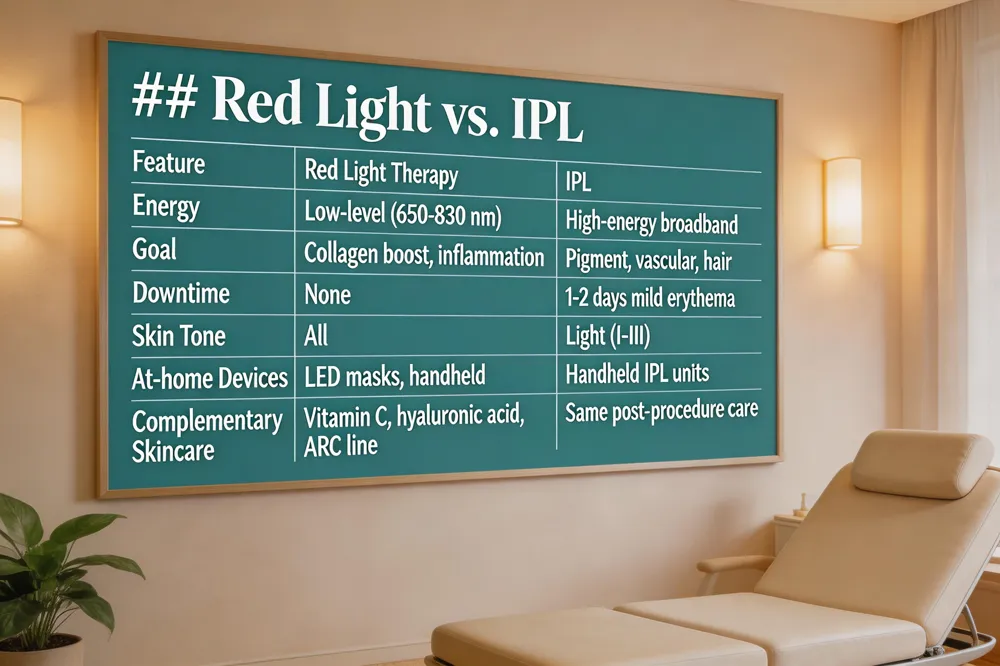 Red Light Therapy (RLT) works through low‑level photobiomodulation: red LEDs or low‑power lasers emit photons (≈650‑830 nm) that are absorbed by mitochondrial cytochrome‑c‑oxidase, boosting ATP production and reducing inflammation. This deep‑penetrating light stimulates collagen synthesis, smooths fine lines, and accelerates healing of acne lesions and post‑procedure skin. RLT is safe for all skin tones, emits no UV radiation, and typically causes only mild redness at high intensities; protective eyewear is advised.
IPL vs. Red Light – IPL delivers high‑energy, broad‑spectrum pulses that target melanin and hemoglobin, making it effective for fading sun spots, rosacea, and hair reduction, but it often requires a few days of mild erythema and is best suited for lighter skin. Red Light™, in contrast, is a gentle, non‑thermal option with no downtime, ideal for soothing irritation after IPL or laser and for ongoing anti‑aging maintenance. Combining the two is common: a treatment packet of IPL or laser followed by a few weeks of RLT can calm inflammation, enhance collagen remodeling, and improve overall results.
Post‑Procedure Skincare – Support the healing cascade with topical antioxidants and hydration. Clinical‑grade options at Timeless Med Spa include ARC Opti‑C Complex serum (Vitamin C), ARC Phyto‑DMAE Cream (firming), and ARC Dermabuff exfoliating scrub for texture refinement. Over‑the‑counter favorites such as TruSkin Vitamin C Serum, CeraVe Skin Renewing Vitamin C, and hyaluronic‑acid moisturizers also provide antioxidant protection and moisture retention. For sensitive or rosacea‑prone skin, ARC Pumpkin Cream and Cleanser deliver soothing, enzyme‑based nourishment without irritation.
At‑Home Light Therapy – Home LED masks and handheld devices can deliver low‑level red light safely when used according to manufacturer guidelines, offering a convenient adjunct to professional sessions. Pair these with a consistent skincare routine—cleanse, tone, moisturize, and sunscreen daily—to protect the rejuvenated skin and maintain a youthful glow.
Conclusion
In summary, IPL offers a versatile, lower‑cost option for superficial concerns such as sun‑damage, mild hyperpigmentation, rosacea, and broad‑area hair reduction, while laser technologies—especially single‑wavelength, fractional, and ablative systems—provide deeper penetration, higher precision, and more dramatic results for deep pigmentation, scar tissue, and significant skin tightening. Cost, downtime, skin‑type compatibility, and the number of required sessions all play a role in choosing the right modality. Because outcomes depend heavily on device settings and practitioner expertise, a personalized skin analysis is essential. At Timeless Med Spa in Berlin, New Jersey, board‑certified clinicians assess your Fitzpatrick skin type, specific concerns, and aesthetic goals to recommend the optimal IPL or laser protocol. Schedule a consultation today to explore a customized, non‑invasive treatment plan that delivers natural‑looking, lasting rejuvenation.