Why Duration Matters for Your Aesthetic Plan
Understanding how long neuromodulators such as Botox or Dysport last is essential for setting realistic patient expectations. When clients know the typical 3‑4‑month window, they can plan touch‑ups that keep wrinkles at bay without sudden surprise. Structured scheduling—often every 3 to 4 months—allows the injector to fine‑tune dosage and technique, preserving natural movement while extending results over time. From a budgeting perspective, predictable intervals help spread costs evenly across the year, making long‑term aesthetic maintenance affordable and stress‑free. Personalized plans that blend proper after‑care, lifestyle tweaks, and occasional filler work further enhance durability and client satisfaction.
General Duration and Influencing Factors
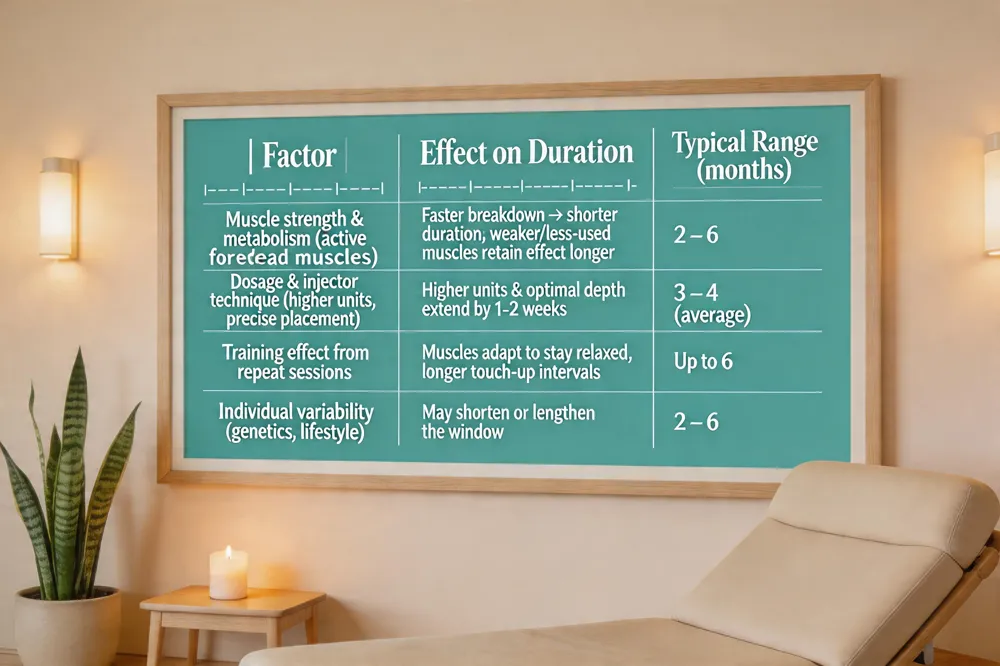
| Factor | Effect on Duration | Typical Range (months) |
|---|---|---|
| Muscle strength & metabolism (e.g., active forehead muscles) | Faster breakdown → shorter duration; weaker/less‑used muscles retain effect longer | 2 – 6 |
| Dosage & injector technique (higher units, precise placement) | Higher units & optimal depth can extend duration by 1‑2 weeks | 3 – 4 (average) |
| Training effect from repeat sessions | Muscles adapt to stay relaxed, allowing longer intervals between touch‑ups | Up to 6 |
| Individual variability (genetics, lifestyle) | May shorten or lengthen the window | 2 – 6 |
Some patients experience up to six months, while others may notice a shorter window of two months, especially after the first treatment.
Muscle strength and metabolism – Heavier, more active muscles (e.g., forehead) break down the toxin faster, and a higher metabolic rate accelerates clearance, shortening longevity. Conversely, weaker or less‑used muscles retain the effect longer.
Dosage and injector technique – Higher unit counts can extend the duration, but safety and a natural look depend on precise placement. An experienced, board‑certified injector ensures optimal depth, spacing, and distribution, which directly influences how long the results last.
Training effect from repeat sessions – Regular, spaced‑out injections train muscles to stay relaxed, often allowing patients to lengthen the interval between touch‑ups over time.
FAQ
- How long does Botox last? Begin work in 3‑5 days, full effect by 1‑2 weeks, lasting ~3‑4 months (up to 6 months for some).
- How long does Dysport last? Onset 2‑3 days, peak around week 1, duration ~3‑5 months, occasionally extending to six months.
- Which lasts longer, Botox or Dysport? Both average 3‑4 months; Botox may edge out Dysport by a few weeks for some, but differences are not clinically significant.
- Does Dysport last longer than Botox? Generally comparable; a few patients feel Botox lasts slightly longer, while Dysport’s broader diffusion can give a smoother feel sooner.
Consistent maintenance every 3‑4 months, combined with a qualified injector and healthy lifestyle habits, maximizes the durability of both neuro‑toxins.
Onset Speed and When Full Results Appear
| Product | Onset (days) | Peak/Full Effect (days) | Typical Duration (months) |
|---|---|---|---|
| Dysport | 2‑3 (occasionally 1‑2) | 7‑10 (peak around 14) | 3‑5 (average) |
| Botox | 3‑5 | 10‑14 | 3‑4 (average) |
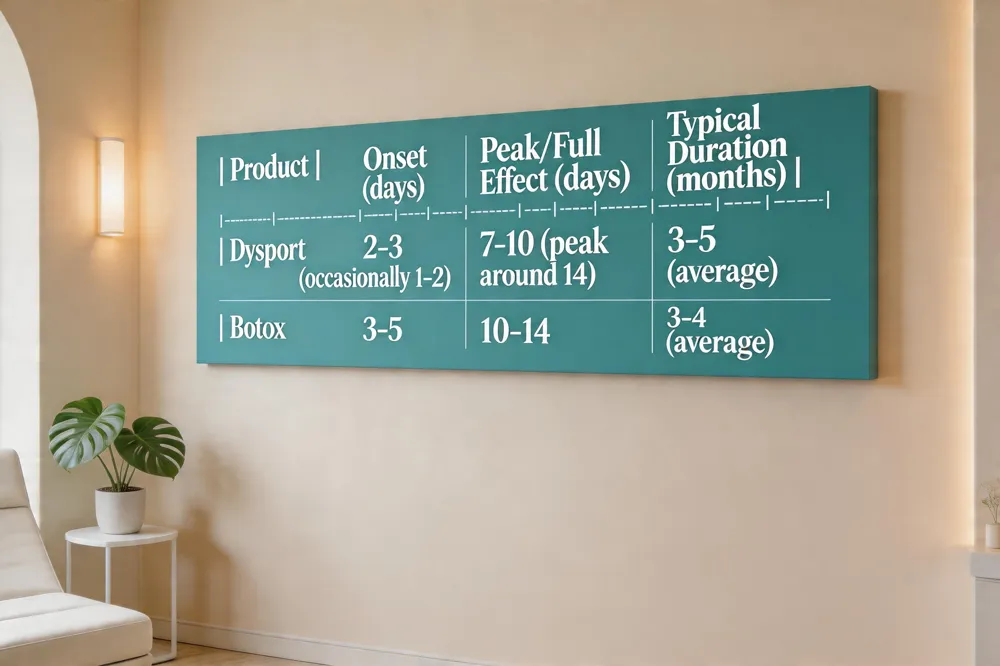 After a Dysport injection most patients notice a subtle smoothing of wrinkles within 2–3 days, with occasional early changes as soon as 24–48 hours. By day 4–5 the effect becomes more pronounced, and the majority of the improvement is visible by the end of the first week. Full, optimal results are typically achieved around 7–10 days, and many clinicians see the peak appearance of smooth skin by two weeks. Botox follows a slightly slower trajectory: initial softening appears around 3‑5 days, and the full effect also peaks at roughly 10‑14 days. The faster onset of Dysport stems from its smaller protein molecule and broader diffusion, making it the quicker option for those seeking early visible change. Both products ultimately reach their maximal result in a similar two‑week window, after which the effect generally lasts three to four months, before a touch‑up is needed.
Area‑Specific Longevity – Eyes, Forehead, and Mouth
| Region | Product | Typical Duration (months) | Notes |
|---|---|---|---|
| Periorbital (eyes) | Botox | 3‑4 (orbicularis oculi may fade slightly earlier) | Full effect 2 weeks, crow’s feet soften 3‑7 days |
| Periorbital (eyes) | Dysport | 3‑5 (up to 6 for slower metabolism) | Similar onset to Botox, broader diffusion |
| Forehead | Botox | 3‑4 (up to 6 with weaker muscles or repeat sessions) | Influenced by frontalis strength, metabolism, stress |
| Perioral (mouth) | Botox | 2½‑3 (first‑time users) up to 4‑6 with repeat | Lip muscles active; after‑care crucial |
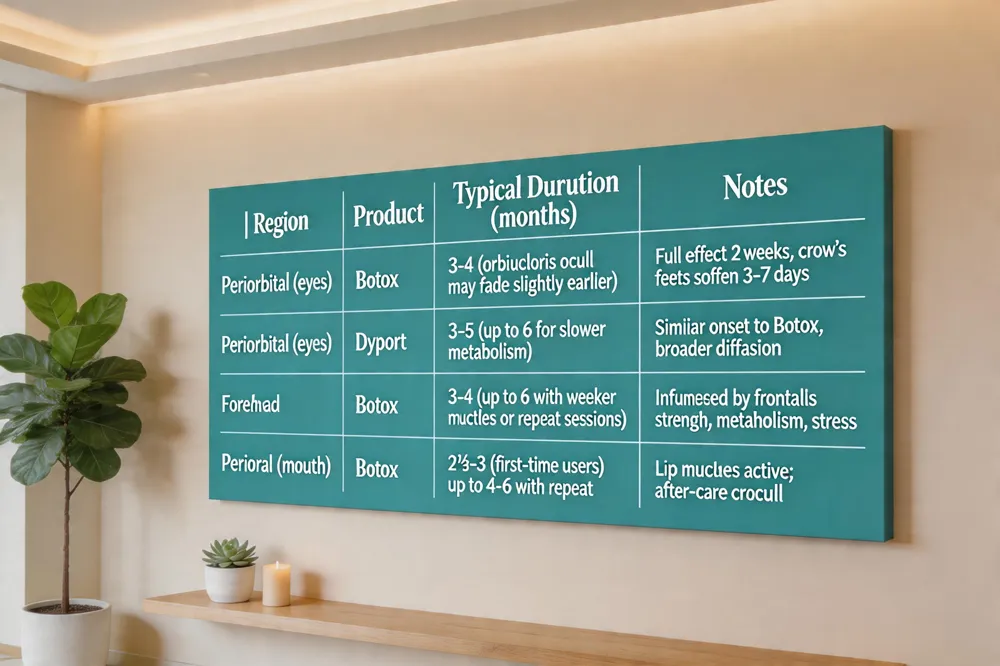 When planning a neuromodulator regimen, it helps to understand how each facial region responds over time.
How long does Botox last around the eyes? Botox injected in the periorbital (eye‑surround) area typically delivers smoothening lasting three to four months. The highly active orbicularis oculi muscle may cause a slightly earlier fade for some patients. Softening of crow’s feet appears within three to seven days, with full effect by two weeks. Duration varies with product amount, placement precision, metabolism, and muscle strength. Most clinicians schedule follow‑ups every three to four months to preserve a natural look.
How long does Botox last on the forehead? Forehead results generally persist three to four months. Strong frontalis muscles, fast metabolism, stress, smoking, sun exposure, or vigorous post‑procedure exercise can shorten this window. Patients with weaker muscles or consistent touch‑ups may enjoy up to six months. Skilled injection technique and appropriate dosing are key to extending longevity.
How long does Botox last around the mouth? Perioral Botox usually lasts three to four months, but the constantly active lip muscles can cause an earlier decline, often around 2½–3 months for first‑time users. Repeat sessions tend to extend the effect as muscles adapt. Proper after‑care—avoiding rubbing, heat, and intense activity for 24 hours—helps maintain results.
How long does Dysport last around the eyes? Dysport’s eye‑area results are comparable to Botox, lasting three to four months for most,, with some experiencing up to five or six months if metabolism is slower or dosage higher. The same post‑care principles—no rubbing, sun protection, and timely maintenance—ensure lasting smoothness.
Dosage, Unit Conversion, and Their Impact
| Product | Typical Units for Glabellar Lines | Equivalent Dysport Units (≈1 Botox = 3 Dysport) | Effect of Higher Dose on Duration |
|---|---|---|---|
| Botox | 20 U | 60 U Dysport | +1‑2 weeks per incremental increase (safety first) |
| Dysport | 60 U | 20 U Botox | Same principle; higher units may modestly prolong effect |
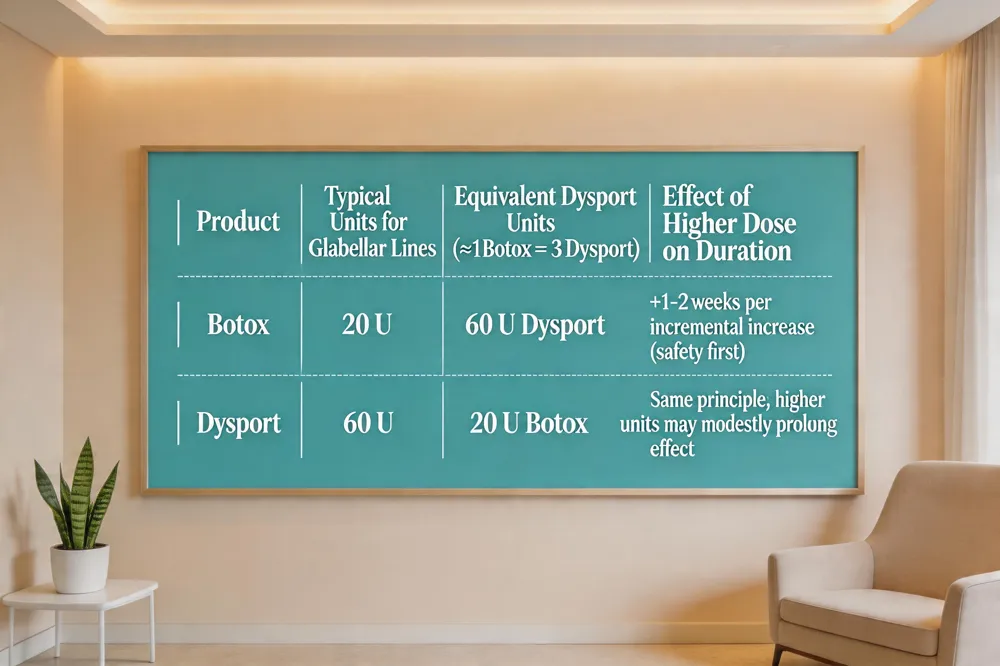 Botox (onabotulinumtoxinA) and Dysport (abobotulinumtoxinA) are not interchangeable on a unit‑for‑unit basis. Clinical data show a conversion of roughly 1 Botox unit ≈ 3 Dysport units, so a typical 20‑unit Botox protocol (used for glabellar lines) translates to about 60 Dysport units for a comparable effect. This ratio can shift slightly with muscle size or individual response, which is why an experienced injector tailors each dose.
Higher doses can modestly prolong the smoothing window—studies report that increasing the amount of toxin may extend results by 1–2 weeks, but safety and a natural look must remain the priority. Regular, spaced treatments also “train” muscles to stay relaxed longer, further lengthening intervals between appointments.
Is 20 units of Botox the same as 20 units of Dysport? No. Because Dysport is roughly three times less potent per unit, 20 Botox units equal about 60 Dysport units for similar efficacy.
How long does Botox last on the hair (hair Botox treatment)? Hair Botox is a keratin‑based conditioning treatment, not a neurotoxin. Results typically endure 8–12 weeks (2–4 months), with diligent after‑care sometimes extending benefits to 5–6 months.
Long‑Term Use, Training Effect, and Emerging Options
| Aspect | Observation | Duration/Effect |
|---|---|---|
| Training effect (muscle adaptation) | Repeated relaxation → subtle muscle atrophy, smoother skin | Over years, intervals between sessions can lengthen |
| Daxxify (daxibotulinumtoxinA) | Peptide‑exchange stabilized neuromodulator | Results typically 6 months, up to 9 months in many patients |
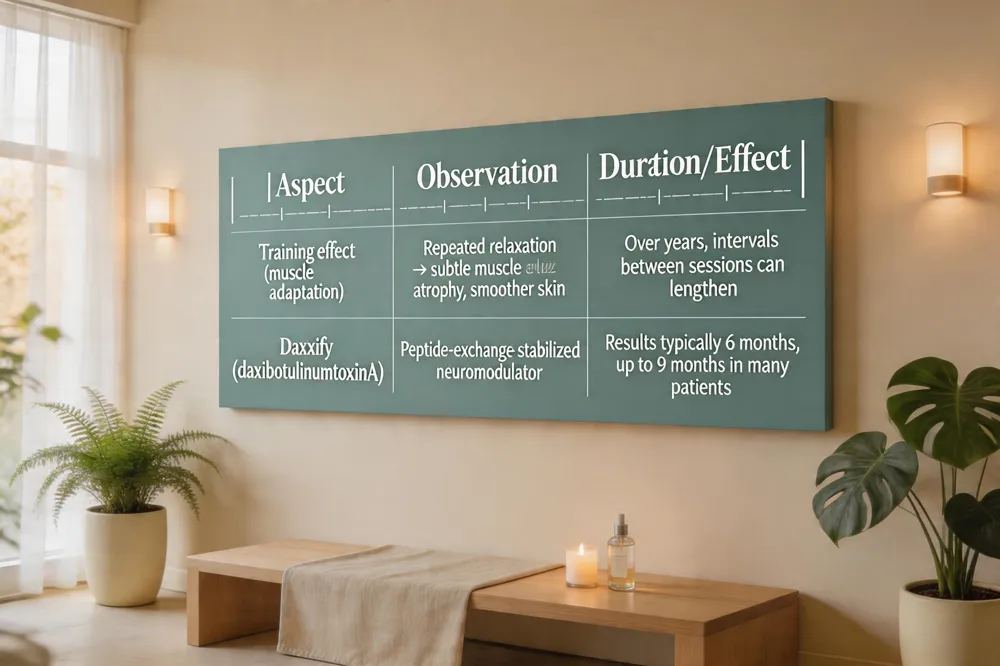 Consistent use of Botox over many years produces a gradual "training" effect on facial muscles. Regular relaxation weakens the muscle fibers, leading to subtle muscle atrophy that helps preserve a smoother skin tone. After two decades of regular Botox treatments, most people show markedly fewer dynamic lines and a smoother, more youthful‑appearing complexion because the repeated muscle relaxation prevents new wrinkles from forming and existing ones from deepening. Small, gradual muscle atrophy can occur in the treated areas, giving the skin a softer, less “animated” look without compromising facial expression. The safety profile remains high, with no evidence of tolerance or long‑term skin damage when administered by a qualified professional. While Botox slows expression‑related aging, natural age‑related changes such as collagen loss still occur, often prompting complementary procedures.
What does Botox look like 20 years after consistent use? After two decades of regular Botox treatments, most people show markedly fewer dynamic lines and a smoother, more youthful‑appearing complexion because the repeated muscle relaxation prevents new wrinkles from form and existing ones from deepening. Small, gradual muscle atrophy can occur in the treated areas, giving the skin a softer, less “animated” look without compromising facial expression. The safety profile remains high, with no evidence of tolerance or long‑term skin damage when the product is administered by a qualified professional. While Botox slows the appearance of expression‑related aging, natural age‑related changes such as loss of collagen and elasticity still occur, often prompting complementary procedures like fillers or laser therapy. Over time, subtle adjustments in dosage or treatment zones may be needed to maintain the desired, natural result.
What is Daxxify? Daxxify (daxibotulinumtoxinA) is an FDA‑approved neuromodulator developed by Revance Aesthetics that treats dynamic facial wrinkles such as glabellar (frown) lines, forehead lines, and crow’s feet. Unlike traditional Botox and Dysport, it is stabilized with a proprietary peptide‑exchange technology and contains no human or animal albumin. This formulation allows Daxxify to remain active at the neuromuscular junction for a longer period, delivering results that typically last six months and can extend to nine months in many patients. It works by temporarily blocking nerve signals to targeted muscles, smoothing the skin above them while preserving natural facial movement. Because of its extended durability, patients often need fewer treatment sessions per year compared with other injectable wrinkle relaxers.
Cost Considerations and Value Comparison
| Product | Unit Price (USD) | Typical Units per Session | Approx Cost per Session (USD) | Notes |
|---|---|---|---|---|
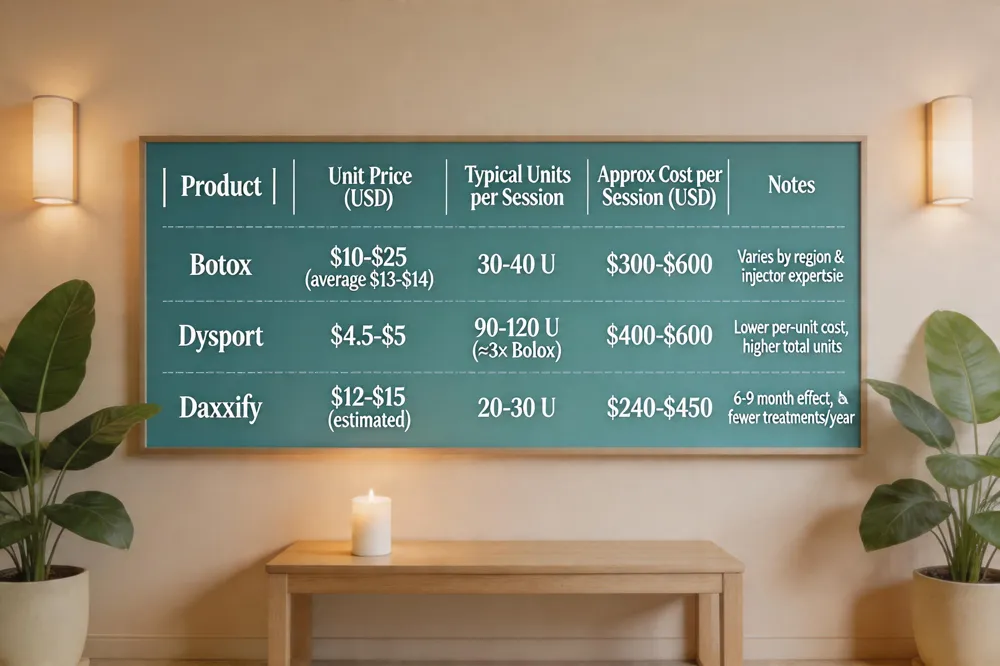
| Botox | $10‑$25 (average $13‑$14) | 30‑40 U (forehead/crow’s feet) | $300‑$600 | Price varies by region & injector expertise |
| Dysport | $4.5‑$5 | 90‑120 U (≈3× Botox) | $400‑$600 (overall similar to Botox) | Lower per‑unit cost but higher total units |
| Daxxify | $12‑$15 (estimated) | 20‑30 U | $240‑$450 (longer durability reduces frequency) | Fewer treatments per year due to 6‑9 month effect |
 How much does Botox cost in the United States?
Botox is typically quoted per unit, ranging from $10–$25 per unit depending on geography and injector expertise. Major metros such as New York or Los Angeles often see $15–$25 per unit, while smaller markets may be $10–$15. A standard session for forehead lines or crow’s feet uses 30–40 units, translating to $300–$600 overall. Total cost varies with the number of treated areas, the provider’s experience, and any ancillary clinic fees.
How much does Botox cost in the United States?
Botox is typically quoted per unit, ranging from $10–$25 per unit depending on geography and injector expertise. Major metros such as New York or Los Angeles often see $15–$25 per unit, while smaller markets may be $10–$15. A standard session for forehead lines or crow’s feet uses 30–40 units, translating to $300–$600 overall. Total cost varies with the number of treated areas, the provider’s experience, and any ancillary clinic fees.
Is Botox or Dysport cheaper overall? Dysport’s per‑unit price is lower (≈ $4.5–$5) compared with Botox (≈ $13–$14). However, Dysport requires about three times the units for an equivalent effect, so the final session price usually aligns with Botox—roughly $400 for Dysport versus $300–$600 for Botox, depending on dosage and clinic pricing.
Budgeting for regular maintenance Plan for touch‑ups every 3–4 months; budgeting $300–$600 per quarter will keep results consistent while allowing flexibility for multiple treatment areas.
Key Takeaways for Strategic Planning
Pick the neurotoxin that fits your lifestyle and appointment calendar. If you need a quicker onset for a special event, Dysport’s 2‑3‑day effect may be ideal; for precise, small‑area work, Botox’s tighter diffusion works well. Always select a board‑certified injector with proven experience—accurate placement, proper dosing, and a gentle technique keep results natural and extend longevity. Finally, plan a realistic budget that includes quarterly touch‑ups; regular maintenance not only preserves smoothness but often trains muscles to stay relaxed longer, potentially stretching the interval between sessions. Consistent, personalized care ensures lasting, natural‑looking rejuvenation. Schedule consultations early to align treatments with seasonal skin‑care.