Overview of Dermal Fillers and Longevity Factors
Dermal fillers come in several families – hyaluronic acid (HA) such as Juvederm and Restylane, calcium hydroxylapatite (CaHA) like Radiesse, poly‑L‑lactic acid (PLLA) Sculptra, and polymethyl‑methacrylate (PMMA) Bellafill. HA products dominate the market, lasting 6‑18 months, while CaHA and PLLA extend to 12‑24 months and PMMA can persist for five years or more. Duration is shaped by the filler’s cross‑link density, viscosity, and placement depth, as well as the treated area’s mobility: high‑movement zones (lips, nasolabial folds) break down faster than low‑movement regions (cheeks, jawline). Individual metabolism, age, sun exposure, smoking, hydration, and after‑care habits also play a role. Because these variables differ from person to person, a personalized treatment plan—selecting the right product, injection technique, and maintenance schedule—ensures natural, lasting results tailored to each client’s anatomy and lifestyle.
Facial Regions and Their Typical Filler Lifespans
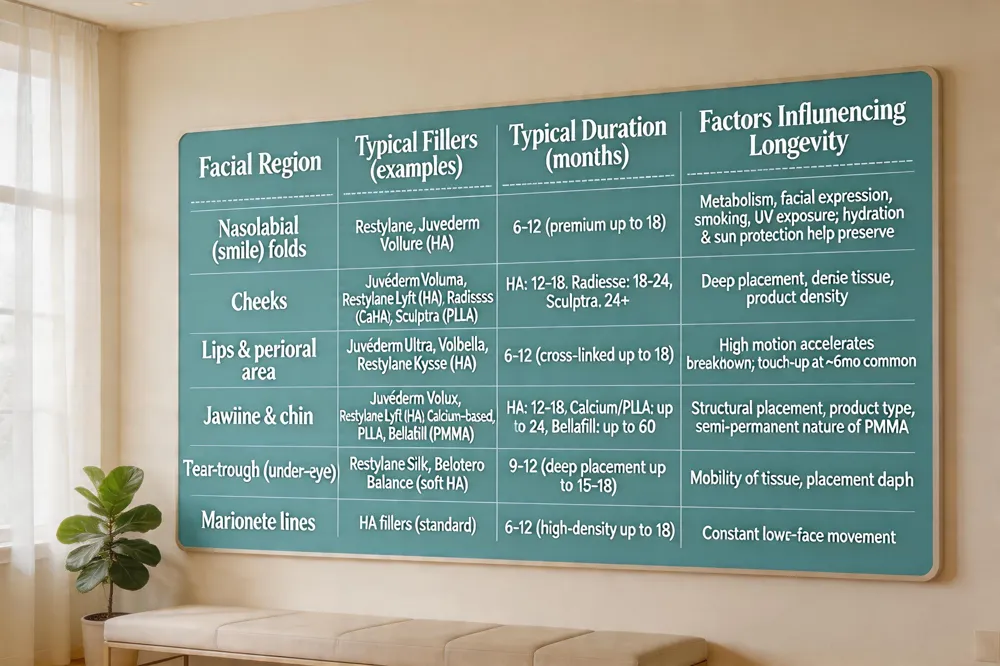
| Facial Region | Typical Fillers (examples) | Typical Duration (months) | Factors Influencing Longevity |
|---|---|---|---|
| Nasolabial (smile) folds | Restylane, Juvederm Vollure (HA) | 6‑12 (premium up to 18) | Metabolism, facial expression, smoking, UV exposure; hydration & sun protection help preserve |
| Cheeks | Juvéderm Voluma, Restylane Lyft (HA); Radiesse (CaHA); Sculptra (PLLA) | HA: 12‑18, Radiesse: 18‑24, Sculptra: 24+ | Deep placement, dense tissue, product density |
| Lips & perioral area | Juvéderm Ultra, Volbella, Restylane Kysse (HA) | 6‑12 (cross‑linked up to 18) | High motion accelerates breakdown; touch‑up at ~6 mo common |
| Jawline & chin | Juvéderm Volux, Restylane Lyft (HA); Calcium‑based, PLLA; Bellafill (PMMA) | HA: 12‑18, Calcium/PLLA: up to 24, Bellafill: up to 60 | Structural placement, product type, semi‑permanent nature of PMMA |
| Tear‑trough (under‑eye) | Restylane Silk, Belotero Balance (soft HA) | 9‑12 (deep placement up to 15‑18) | Mobility of tissue, placement depth |
| Marionette lines | HA fillers (standard) | 6‑12 (high‑density up to 18) | Constant lower‑face movement |
 Nasolabial (smile) folds: hyaluronic‑acid fillers such as Restylane or Juvederm Vollure usually last 6‑12 months, with premium, higher‑density gels extending to 18 months. Metabolism, facial expression, smoking and UV exposure can shorten this, while hydration and sun protection help preserve the result.
Cheeks: deeper placement and denser tissue give longer durability. Juvéderm Voluma and Restylane Lyft typically provide 12‑18 months of volume, calcium‑hydroxyapatite (Radiesse) can reach 18‑24 months, and PLLA stimulators (Sculptra) may last 2 years or more.
Lips and perioral area: HA lip fillers (e.g., Juvéderm Ultra, Volbella, Restylane Kysse) generally persist 6‑12 months; more cross‑linked formulations may approach 18 months. High motion accelerates breakdown, so a touch‑up at ~6 months is common.
Jawline and chin: structural fillers like Juvéderm Volux or Restylane Lyft give 12‑18 months, while calcium‑based or PLLA products can extend to 24 months. The longest‑lasting option is Bellafill (PMMA‑collagen), lasting up to 5 years, though it is semi‑permanent.
Tear‑trough (under‑eye) soft HA gels (Restylane Silk, Belotero Balance) typically last 9‑12 months; deeper, less mobile placement can push durability toward 15‑18 months.
Marionette lines due to constant lower‑face movement, HA fillers usually fade 6‑12 months; higher‑density formulations may reach 18 months. Maintenance touch‑up every 6‑12 months keep these areas smooth and natural.
What Influences How Long a Filler Persists?
| Factor | Description | Impact on Duration |
|---|---|---|
| Product formulation & cross‑link density | Highly cross‑linked HA (e.g., Voluma) vs. low‑viscosity gels | Higher cross‑link → longer persistence (upper range of 6‑18 mo) |
| Injection depth & tissue type | Deep placement on bone or dense fat vs. superficial thin skin | Deep, dense tissue → 12‑24 mo; superficial → 6‑12 mo |
| Metabolism, age, lifestyle | Faster metabolism, smoking, UV exposure accelerate breakdown | Can shorten expected duration by several months |
| After‑care practices | Hydration, broad‑spectrum SPF, avoiding intense massage | Helps preserve volume, may extend longevity |
| Detectability on imaging | HA fillers detectable on MRI for ≥2 yr; trace up to 15 yr | Shows that some filler remnants persist beyond clinical effect |
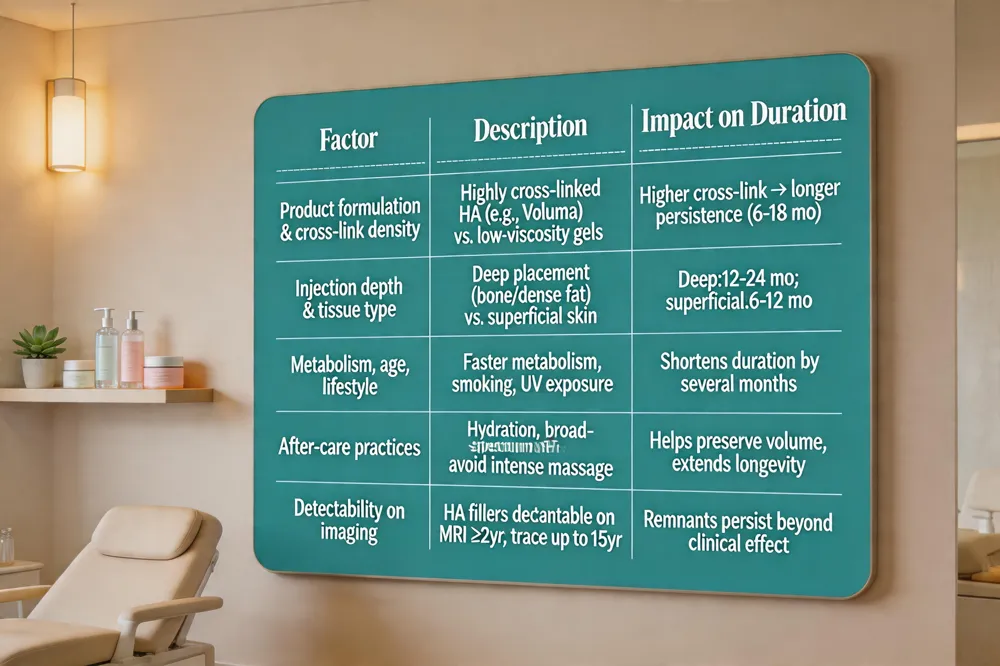 The durability of a dermal filler is shaped by several interacting factors. First, product formulation and cross‑link density matter: highly cross‑linked hyaluronic‑acid (HA) gels such as Juvéderm Voluma and Restylane Lyft tend to linger toward the upper end of the 6‑18‑month range, while softer, low‑viscosity fillers dissolve faster, especially in high‑movement zones. Second, injection depth and tissue type influence longevity; deep placement along bone or within dense fat pads (e.g., cheek or jawline) provides a stable scaffold that can last 12‑24 months, whereas superficial placement in thin, mobile skin (lips, nasolabial folds) accelerates breakdown. Third, metabolism, age, and lifestyle play a role—individuals with faster metabolic rates, frequent smoking, or excessive UV exposure may see earlier fading. Fourth, after‑care practices such as diligent hydration, daily broad‑spectrum SPF, and avoiding intense facial massage help preserve volume. Finally, research findings reveal that HA filler can remain detectable on MRI for at least two years, with some patients retaining trace amounts up to 15 years, challenging the conventional 3‑12‑month rule.
Choosing the Longest‑Lasting Filler for Each Goal
| Goal / Region | Recommended Filler(s) | Typical Duration | Key Notes |
|---|---|---|---|
| Cheek augmentation (volume) | Juvederm Voluma (HA) | up to 24 mo | Highly cross‑linked HA; deep placement |
| General facial volume & collagen stimulation | Radiesse (CaHA) | 12‑24 mo (some >24) | Calcium microspheres stimulate collagen |
| Long‑term collagen boost | Sculptra (PLLA) | ~24 mo after series | Biostimulatory, gradual effect |
| Semi‑permanent solution (nasolabial, acne scars) | Bellafill (PMMA‑collagen) | 5‑6 yr (up to 10 yr) | PMMA microspheres; requires careful patient selection |
| Lip enhancement | Juvederm Ultra XC, Volbella, Restylane Kysse (HA) | 12‑18 mo (high‑density) | High motion area; touch‑up at 6‑12 mo common |
| Tear‑trough (under‑eye) | Soft HA gels (Restylane Silk, Belotero Balance) | 9‑12 mo (deep placement up to 15‑18) | Gentle placement to avoid Tyndall effect |
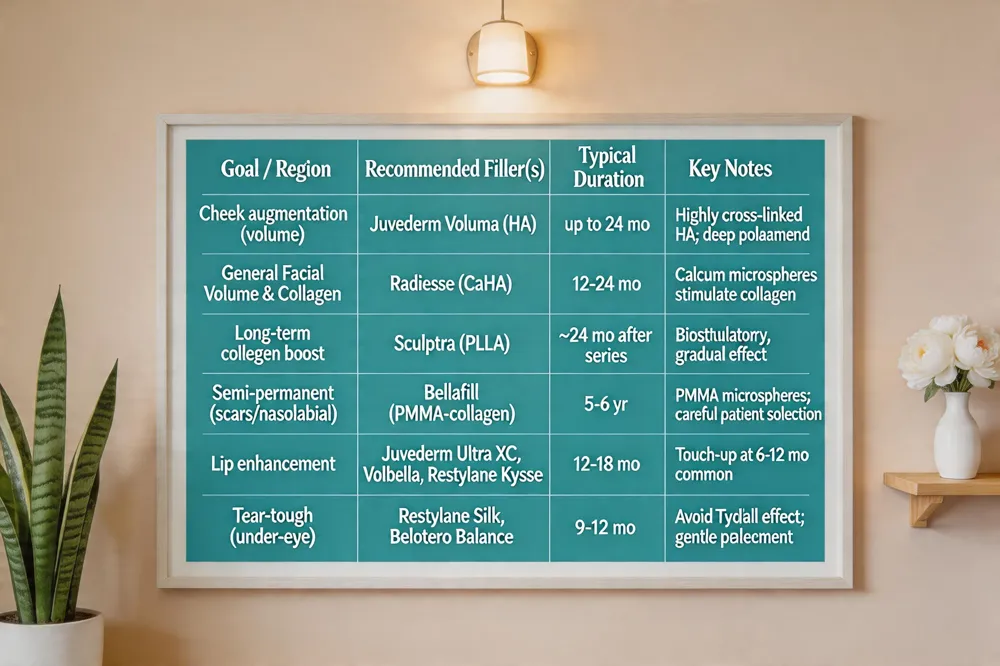 When longevity is the primary concern, three products consistently rank highest. Juvederm Voluma (a cross‑linked hyaluronic‑acid gel used for cheek augmentation) can retain volume for up to two years with proper maintenance. Radiesse, a calcium‑hydroxyapatite filler that also stimulates collagen, typically lasts 12‑18 months, with some patients seeing results beyond a year. Sculptra, a poly‑L‑lactic‑acid collagen‑stimulating filler, builds new collagen gradually and can provide a lasting improvement of about two years after the full treatment series.
Cheek‑specific longevity: The longest‑lasting HA option for cheek volume is Juvederm Voluma (up to 24 months). Radiesse offers comparable durability (12‑18 months), while Restylane Lyft delivers a solid 12‑month effect. For patients who prefer a biostimulatory approach, Sculptra can sustain results for up to two years, though the effect appears more slowly.
Five‑year solution: Bellafill (PMMA microspheres in a collagen gel) is the only FDA‑cleared filler that can persist for five to six years, particularly for nasolabial folds and acne‑scar depressions. Sculptra may approach the five‑year mark for some individuals after a full series, but Bellafill remains the definitive semi‑permanent choice.
Longest‑lasting lip filler: Among HA products, Juvederm Ultra XC, Juvederm Volbella, and Restylane Kysse provide the best durability, typically lasting up to 12 months and occasionally longer. Calcium‑hydroxyapatite fillers can extend lip longevity to 15‑18 months, though they are used less frequently in this high‑movement area.
Overall, the best filler for any region balances durability with safety, injection technique, and the patient’s metabolism. At Timeless Med Spa, we tailor product selection—whether Juvederm Voluma, Restylane Lyft, Radiesse, Sculptra, or Bellafill—to each individual’s aesthetic goals and lifestyle for natural, long‑lasting results.
Cost, Value, and Practical Planning
| Filler / Product | Avg Price per 1‑mL Syringe (USD) | Typical Duration | Approx. Cost per Month* | Notes |
|---|---|---|---|---|
| Bellafill (PMMA) | $600‑$800 (clinic $900‑$1,000) | 5‑6 yr | $11‑$17 | Packages lower per‑unit price; full‑face protocol $3,600‑$4,000 |
| HA fillers (average) | $750 (US avg) | 6‑12 mo (HA up to 18) | $62‑$125 | Regional variation: CA $900‑$1,200, CO $775‑$1,050, CT $850‑$1,150, DE $750‑$1,000 |
| Radiesse (CaHA) | $800‑$950 | 12‑24 mo | $33‑$79 | Often 1‑2 syringes per session |
| Sculptra (PLLA) | $650‑$800 per vial (multiple sessions) | ~24 mo | $27‑$33 | Requires series of 3‑4 treatments |
| Lip HA fillers | $700‑$850 | 6‑12 mo | $58‑$71 | Touch‑up every 6‑12 mo recommended |
| *Cost per month = (Price per syringe) ÷ (Duration in months). |
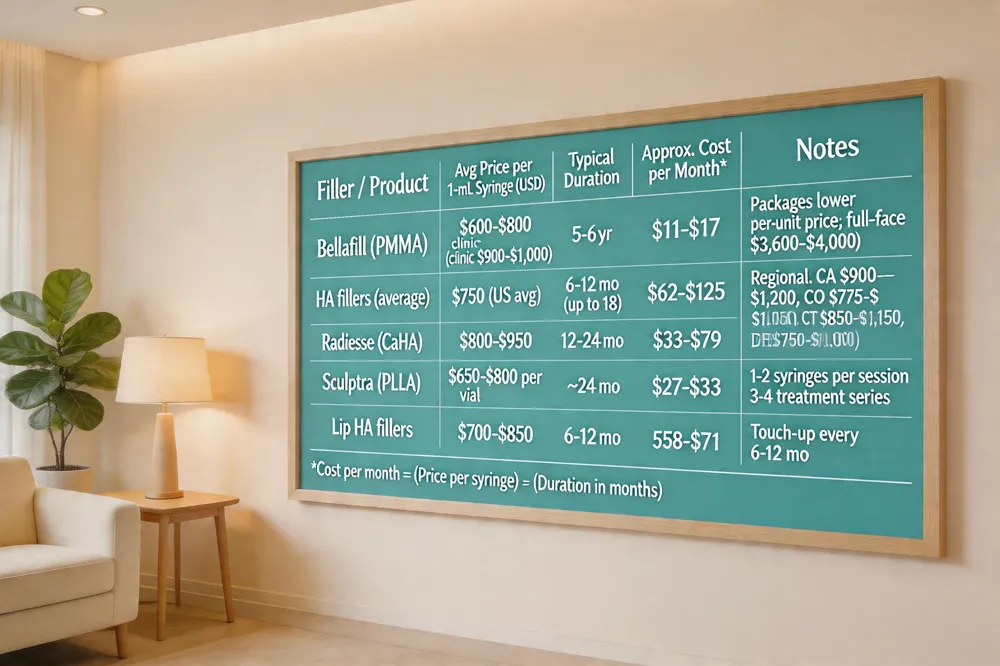 When planning a dermal‑filler regimen, understanding the true cost versus the lasting value is essential.
Bellafill pricing – Bellafill is a semi‑permanent filler that can endure up to five years. In 2025 a 1‑mL syringe typically runs $600‑$800, but many clinics quote $900‑$1,000 per syringe to cover provider expertise and facility fees. Packages of multiple syringes lower the per‑unit price to $720‑$800, and a full‑face protocol may require several syringes, bringing the overall investment to $3,600‑$4,000.
Average filler cost per syringe – Across the United States the average price for a 1‑mL HA filler is about $750. Regional variations are common: $900‑$1,200 in California, $775‑$1,050 in Colorado, $850‑$1,150 in Connecticut, and $750‑$1,000 in Delaware. Most treatments use 2–3 syringes, so patients can expect $1,800‑$2,400 total, including consultation and injection fees.
Budgeting for maintenance touch‑ups – Because HA fillers naturally break down, most clinicians recommend touch‑ups every 6‑12 months, depending on the treated area. Planning for a yearly $800‑$1,200 allocation for a touch‑up syringe helps keep results consistent without surprise expenses. At Timeless Med Spa we provide a personalized quote after a thorough assessment, ensuring transparency and a clear maintenance schedule that aligns with each client’s aesthetic goals.
Safety, Risks, and Special Patient Considerations
| Consideration | Details | Mitigation / Recommendations |
|---|---|---|
| High‑risk injection sites (glabella, forehead) | Superficial vessels → risk of occlusion, necrosis, vision loss | Use blunt‑tip cannulas, aspiration, incremental dosing, experienced injector |
| Long‑term filler remnants | HA, CaHA, PLLA metabolize within years; PMMA may persist | Monitor for late nodules, surgical removal if needed |
| Older patients (≥70 yr) | Skin elasticity reduced; risk of over‑correction | Choose appropriate filler (HA for fine lines, Radiesse/Sculptra for volume), thorough assessment |
| Lifestyle factors (smoking, UV) | Accelerate degradation | Advise cessation, sunscreen, hydration |
| Allergic / hypersensitivity reactions | Rare but possible with any product | Perform allergy testing, detailed medical history, have hyaluronidase on hand for HA fillers |
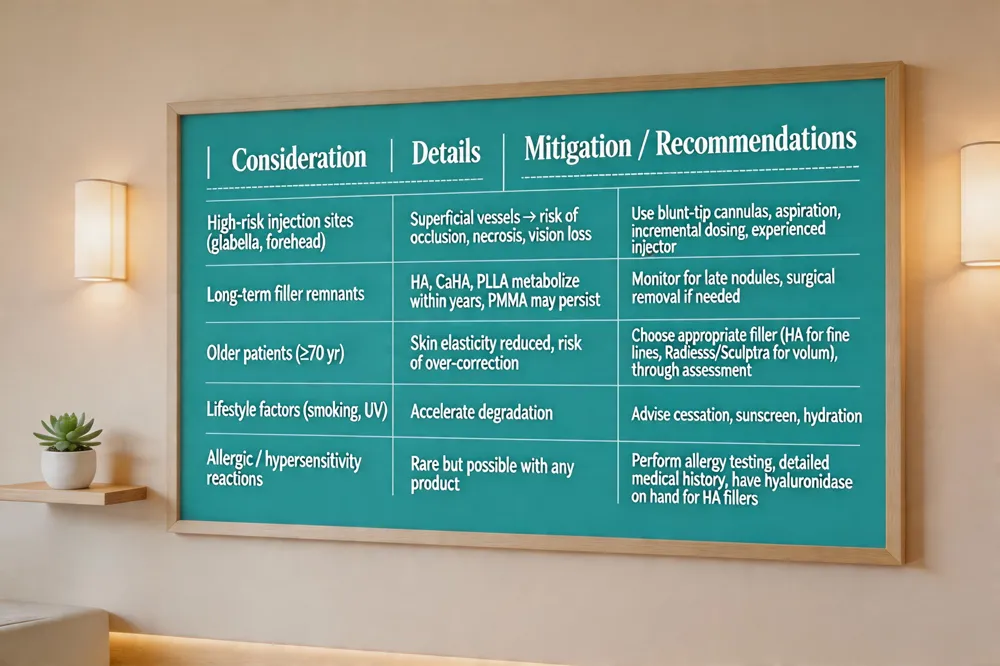 High‑risk injection sites such as the glabella and forehead carry the greatest danger because superficial vessels lie just under the skin; accidental occlusion can cause necrosis or vision loss. Using blunt‑tip cannulas, aspiration, and incremental dosing by an experienced injector reduces these risks.
Long‑term filler remnants: most HA, CaHA, and PLLA fillers are fully metabolized within a few years, so after 20 years they are gone. Only semi‑permanent products like PMMA microspheres may persist, potentially causing late nodules or asymmetry that require surgical removal.
Older patients: age alone is not a contraindication. A 70‑year‑old woman with reasonable skin elasticity can benefit from HA fillers for fine lines and from sturdier agents (Radiesse, Sculptra) for volume loss. A thorough assessment ensures realistic expectations and safe treatment.
Putting the Pieces Together for a Personalized Plan
Balancing longevity with safety means selecting a filler that lasts long enough to meet your aesthetic goals yet remains reversible if needed. Hyaluronic‑acid products such as Juvéderm Voluma or Restylane Lyft provide 12‑18 months of volume in low‑movement areas (cheeks, jawline) while still being dissolvable with hyaluronidase, protecting against over‑correction. Maintenance appointments are the backbone of a durable plan; scheduling touch‑ups every 9‑12 months (or sooner in high‑mobility zones like the lips) preserves results, reduces the amount of filler needed at each visit, and allows the injector to adjust for metabolic changes, sun exposure, or lifestyle factors. Tailoring filler choices to individual goals involves matching product viscosity and cross‑link density to the targeted region—dense, cohesive gels for structural support in the chin or jawline, softer low‑viscosity fillers for delicate under‑eye work, and dynamic RHA formulations for mobile zones. By integrating these considerations, a personalized protocol delivers natural, lasting enhancement while prioritizing patient safety and comfort.