Why Modern Laser Resurfacing Matters
Laser resurfacing has evolved from early ablative CO₂ and Er:YAG systems, which required weeks of recovery, to today's fractional, hybrid, and picosecond platforms that create microscopic treatment columns, preserve surrounding tissue, and dramatically shorten downtime. Advanced cooling, AI‑driven skin mapping, and wavelength selection now make these devices safe for every Fitzpatrick skin type, reducing the risk of hyper‑ or hypopigmentation even in darker tones. By delivering controlled heat or ultra‑short pulses, modern lasers trigger a natural healing cascade that stimulates new collagen and elastin, tightening skin, smoothing fine lines, and fading sun‑damage and scars. Patients can expect a personalized, physician‑led plan that delivers natural‑looking rejuvenation with minimal disruption—often just a few days of mild redness—allowing them to resume daily activities quickly while enjoying long‑lasting, healthier skin.
Fundamentals & Safety of Laser Skin Resurfacing
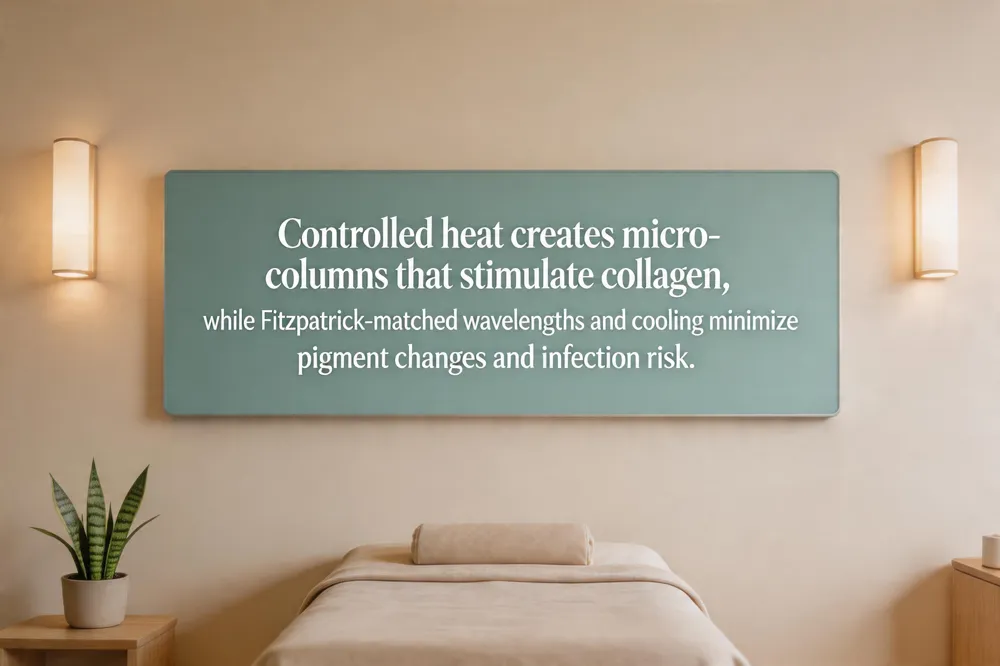 Laser skin resurfacing works by delivering controlled heat or light energy to the epidermis and upper dermis, creating microscopic treatment columns that trigger the body’s natural healing cascade. This response stimulates new collagen and elastin fibers, tightening the skin and improving texture. Modern devices are programmed to match each patient’s Fitzpatrick skin type, using wavelengths and fluences that minimize the risk of hyper‑ or hypopigmentation while still achieving deep dermal remodeling.
Before the resurfacing most line lines, sun spots, uneven tone, and mild laxity are visible; after treatment the same areas appear smoother, firmer, and more radiant, as documented in before‑and‑after photos. Laser resurfacing is a highly effective, nonsurgical option for skin health, reducing pigmentation, fine lines, and acne scarring without the downtime of surgery.
For safe facial resurfacing, non‑ablative fractional lasers, gentle chemical peels, microdermabrasion, or microneedling with growth‑factor serums are preferred. A thorough pre‑procedure plan—stopping retinoids, avoiding sun, and using prophylactic antiviral medication when needed—combined with intra‑procedure cooling and post‑care protocols (hydrating ointments, SPF 30+ sunscreen, and gentle cleansing) ensures optimal results and minimal complications. Ongoing maintenance and sun protection preserve the youthful glow for years.
Ablative vs. Non‑Ablative Lasers, Downtime & Risks
 What is the downside of CO₂ laser resurfacing on face?
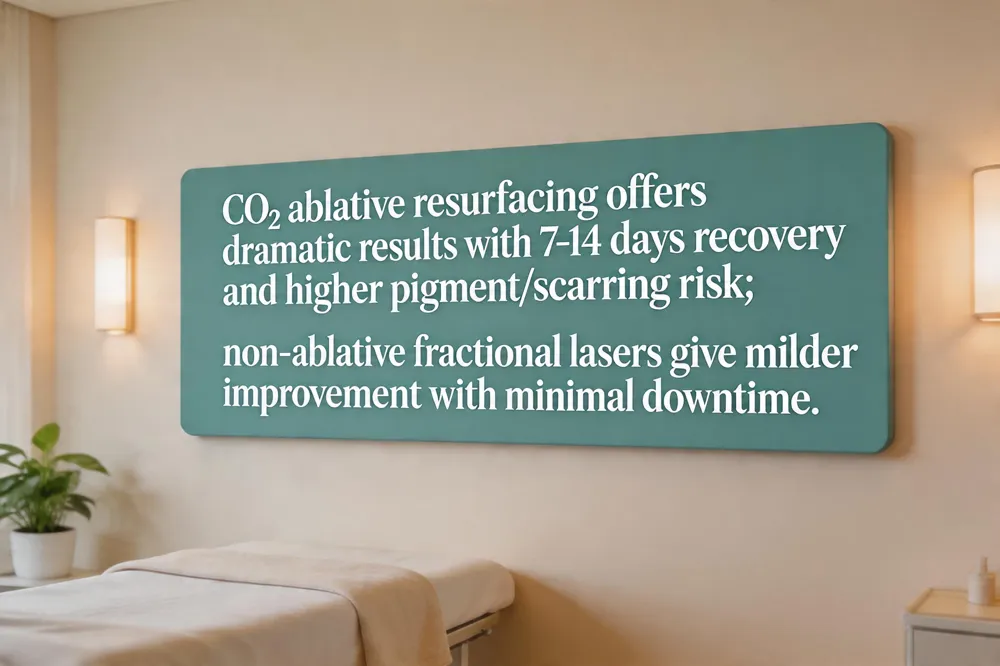
CO₂ resurfacing vaporizes the outer epidermis, creating a controlled wound that can take 7‑14 days to heal. Patients experience pronounced redness, swelling, peeling and a risk of infection, hyper‑ or hypopigmentation—especially in darker Fitzpatrick skin tones. The intense heat also raises the chance of scarring and temporary tightness, requiring diligent sun protection and after‑care.
What is the downside of CO₂ laser resurfacing on face?
CO₂ resurfacing vaporizes the outer epidermis, creating a controlled wound that can take 7‑14 days to heal. Patients experience pronounced redness, swelling, peeling and a risk of infection, hyper‑ or hypopigmentation—especially in darker Fitzpatrick skin tones. The intense heat also raises the chance of scarring and temporary tightness, requiring diligent sun protection and after‑care.
laser skin resurfacing side effects Typical short‑term effects include redness, swelling, bruising, and a tight sensation that fade within days to weeks. Rare but serious complications are infection, persistent pigment changes, milia, or keloid scarring. Proper cooling, test spots, and post‑procedure sunscreen mitigate these risks.
laser skin resurfacing cost Prices vary by technology and region. Nationally, a single facial session ranges from $1,200‑$3,500. Ablative CO₂ or Er:YAG treatments often cost $2,500‑$5,000, while non‑ablative and hybrid options fall between $900‑$2,000. Timeless Med Spa in Berlin, NJ provides a personalized quote after a board‑certified consultation.
laser skin resurfacing near me Timeless Med Spa offers both ablative (fractional CO₂) and non‑ablative (1540 nm, Picosecond) laser resurfacing tailored to your skin type and downtime preferences. Schedule a consultation to explore safe, physician‑led rejuvenation right in Berlin, NJ.
Newest Laser Technologies Redefining Resurfacing
 Modern resurfacing has leapt forward with ultra‑precise devices that balance dramatic results and gentle recovery. UltraClear™ with Laser‑Coring™ is the first FDA‑cleared cold‑fiber ablative system (2910 nm) that creates microscopic micro‑columns (≈360 µm) to remove aged tissue while sparking deep collagen and elastin growth. Downtime is 2‑5 days, and the 2‑910 nm wavelength is safe for all Fitzpatrick tones, delivering a mini‑facelift effect without surgery.
Picosecond lasers (PicoSure®) use trillion‑second pulses to shatter pigment and stimulate remodeling, ideal for melasma, tattoos and scar tissue with only 24‑48 hours of redness.
Hybrid fractional platforms (Halo®, Sciton HALO) blend ablative CO₂ and non‑ablative Er:YAG wavelengths in a single pass, customizing depth while minimizing heat damage—perfect for diverse skin tones.
AI‑driven treatment planning now maps each patient’s skin type and concern in real‑time, automatically adjusting fluence and density for optimal safety.
These advances make laser resurfacing more inclusive, quicker, and naturally rejuvenating before ever before.
Age, Skin Type & Patient Suitability
 Laser resurfacing is not limited by age; patients in their 70s can safely undergo treatment when health and skin elasticity are evaluated. Modern fractional and ablative devices (e.g., CO₂, Fraxel, UltraClear) use customizable energy settings and cooling, allowing comfortable procedures and the healing even for mature skin. Fitzpatrick skin typing guides wavelength selection—longer wavelengths (Nd:YAG, 1064 nm) and lower fluence are preferred for darker tones (IV‑VI) to minimize hyperpigmentation. Contra‑indications include pregnancy, active infections, recent isotretinoin use, uncontrolled connective‑tissue disease, and certain medications; a thorough medical history is essential. Personalized planning—starting with lower‑energy test spots, spacing sessions appropriately, and prescribing strict post‑care (sun protection, hydration, gentle moisturizers)—optimizes outcomes and reduces downtime. Costs vary: non‑ablative options $600‑$900 per session, ablative CO₂ $2,500‑$5,000, with financing often available.
Targeted Solutions: Acne, Scars & Pigmentation
 AviClear laser is an FDA‑cleared, non‑ablative device that targets the sebaceous gland to curb inflammatory acne. Treatments last about 30 minutes, work on all Fitzpatrick skin tones, and require minimal downtime. Patients typically see smoother texture and fewer new lesions after a series of sessions, with results lasting up to a year.
For acne‑scar remodeling, clinicians choose between ablative and non‑ablative options. Fractional CO₂ and erbium‑glass lasers create microscopic columns that vaporize scar tissue, stimulating deep collagen remodeling—ideal for deep ice‑pick or boxcar scars. Non‑ablative fractional lasers such as Fraxel® heat the dermis while preserving the epidermis, making them suitable for superficial to moderate depressions and post‑inflammatory redness. Vbeam® vascular lasers address erythematous scars with little downtime.
Halo® hybrid fractional laser can safely remove seborrheic keratosis. By delivering ablative and non‑ablative wavelengths to micro‑treatment zones, it vaporizes the lesion and improves surrounding texture, typically requiring one to two sessions with only a few days of redness.
Fractional lasers can reduce the appearance of melasma but do not cure it; results vary with skin health.
Laser treatment for keratosis pilaris generally costs $600‑$900 per session in the U.S., depending on the technology and area treated.
At‑Home & Non‑Clinic Laser Options
 When choosing a home device for facial rejuvenation, the Lyma Laser Device tops the list for its low‑level cold‑laser that safely stimulates collagen across all skin tones with zero downtime. For fine‑line reduction, the Nira Pro 3 Laser offers targeted red‑light therapy in 15‑30‑minute sessions, while the Tria FRX Fractional Laser brings clinic‑like fractional technology to the consumer market, delivering noticeable pigment and texture improvements.
Home‑based resurfacing works by delivering low‑intensity, non‑fractional energy that encourages collagen remodeling without the pronounced heating of professional fractional lasers. Results are modest—smoothening fine lines and brightening hyperpigmentation—but deeper wrinkles or severe scarring still require in‑office treatment by a board‑certified physician.
Cost varies widely: professional sessions range from $500 to $3,000, with an average $1,829 per treatment. At Timeless Med Spa, a small‑area non‑ablative session starts near $300, while CO₂ fractional work can exceed $1,600.
Before‑and‑after photos of UltraClear‑type lasers show rapid fading of dark spots, smoother texture, and firmer skin after a single session, with continued improvement over a short series of treatments.
Facial Concerns: Wrinkles, Tightening & Hair Removal
 Laser wrinkle reduction – Modern laser systems fall into two main groups. Ablative devices such as CO₂ and Er:YAG vaporize the outer skin layer and deliver deep heat, yielding dramatic improvement for deep lines after a single session, but they require a week‑plus of downtime. Non‑ablative options—including fractional CO₂, Fraxel and pulsed‑dye lasers create microscopic micro‑injuries that stimulate collagen with minimal redness, making them ideal for fine lines and early‑stage wrinkles. The choice depends on wrinkle depth, skin type and how quickly you want to resume normal activities.
Skin tightening – For facial firmness, a non‑ablative fractional Nd:YAG laser (e.g., Laser Genesis) gently heats the dermis, triggering new collagen and elastin without surface damage. It works for all Fitzpatrick tones and offers zero downtime. Deeper lifts can be achieved with hybrid platforms such as SkinTyte™ or Sciton Halo, which combine ablative and non‑ablative wavelengths but may involve a short recovery period.
Facial hair removal – IPL, diode, alexandrite and Nd:YAG lasers each target hair follicles differently. IPL suits light skin and fine hair; diode lasers excel on medium‑to‑dark skin with coarse hair; alexandrite is best for fair skin; Nd:YAG penetrates deeper and is safest for darker tones.
Cost considerations – Ablative resurfacing typically ranges from $2,500‑$5,000 per session, while non‑ablative fractional treatments average $1,300‑$1,800. Prices vary by device, provider expertise and geographic market. In Orlando, reputable clinics offer both options, allowing a personalized plan that balances results, downtime and budget.
Summing Up: Patient Journey & Future Outlook
 Key take‑aways from this guide are that laser‑based resurfacing delivers measurable collagen remodeling, improves texture, and can be tailored to any Fitzpatrick skin type when proper wavelengths and cooling are used. Long‑term maintenance hinges on disciplined sun protection, gentle moisturization, and periodic touch‑up sessions—typically every 6‑12 months—to sustain the renewed dermal matrix. Emerging trends point toward AI‑driven treatment maps, hybrid fractional systems that fuse ablative and non‑ablative pulses, and picosecond technologies that shatter pigment with virtually no downtime, all of which promise safer, faster results for diverse patients. At Timeless Med Spa Berlin NJ, Dr. Carol Eisenstat leads each program with a personalized, physician‑led approach, matching laser settings to individual skin concerns and lifestyle.
Resurfacing facial: A resurfacing facial is a non‑invasive treatment that uses nanofractional radio‑frequency (RF) or laser technology to create micro‑thermal channels in the skin, stimulating collagen production and enhancing product absorption. It smooths fine lines, wrinkles, acne scars, enlarged pores, uneven texture, hyperpigmentation, and sun‑damage, leaving the complexion brighter, firmer, and healthier. The procedure is safe for all skin tones and typically takes about 15 minutes, with mild redness that may last up to 24 hours. After the session, patients are advised to reapply a medical‑grade hyaluronic‑acid serum throughout the day and continue their regular skincare routine for optimal results. With regular sessions every 10 days, the benefits become both immediate and cumulative, promoting natural enhancement and graceful aging.
Your Path to Safer, Smarter Skin Renewal
At Timeless Med Spa in Berlin, NJ, every laser rejuvenation plan is built around your unique skin type, concerns, and goals. After a thorough consultation, Dr. Carol Eisenstat selects the optimal device—whether the FDA‑cleared UltraClear™ laser‑coring system, 3DMIRACL™ three‑dimensional resurfacing, Fraxel® Dual, CO₂ fractional, or the picosecond‑Sure®—and custom‑tunes wavelength, depth and downtime to match your Fitzpatrick tone and medical history. Safety is our top priority: we educate patients on pre‑treatment steps such as stopping retinoids, sun avoidance and antiviral prophylaxis, and we employ integrated cooling, real‑time monitoring and board‑certified oversight throughout each session. Ready to start? Schedule a virtual or in‑person evaluation, discuss financing options, and let us guide you toward natural, lasting results with confidence for years in your daily life.